Understanding Race Conditions and Concurrency Problems: A Complete Developer’s Guide
Introduction: When $1,000 Becomes Negative
Imagine you’re running a banking application. A customer has $1,000 in their account. Two withdrawal requests arrive at almost the same instant:
- User A wants to withdraw $700
- User B wants to withdraw $500
Both requests check the balance. Both see $1,000. Both confirm sufficient funds. Both proceed. The account ends up at –$200.
No fraud. No malicious code. Just two threads doing exactly what they were told at the wrong moment.
This is a race condition: a class of bugs where the correctness of your program depends on the precise timing and ordering of concurrent operations. Race conditions are among the most dangerous defects in software development. They’re intermittent, hard to reproduce, nearly invisible in code review, and catastrophic in production, especially in systems handling money, health records, or critical infrastructure.
In this guide, you’ll learn exactly what causes them, how to find them, and most importantly, how to eliminate them.

Before understanding race conditions, you need to understand concurrency itself.
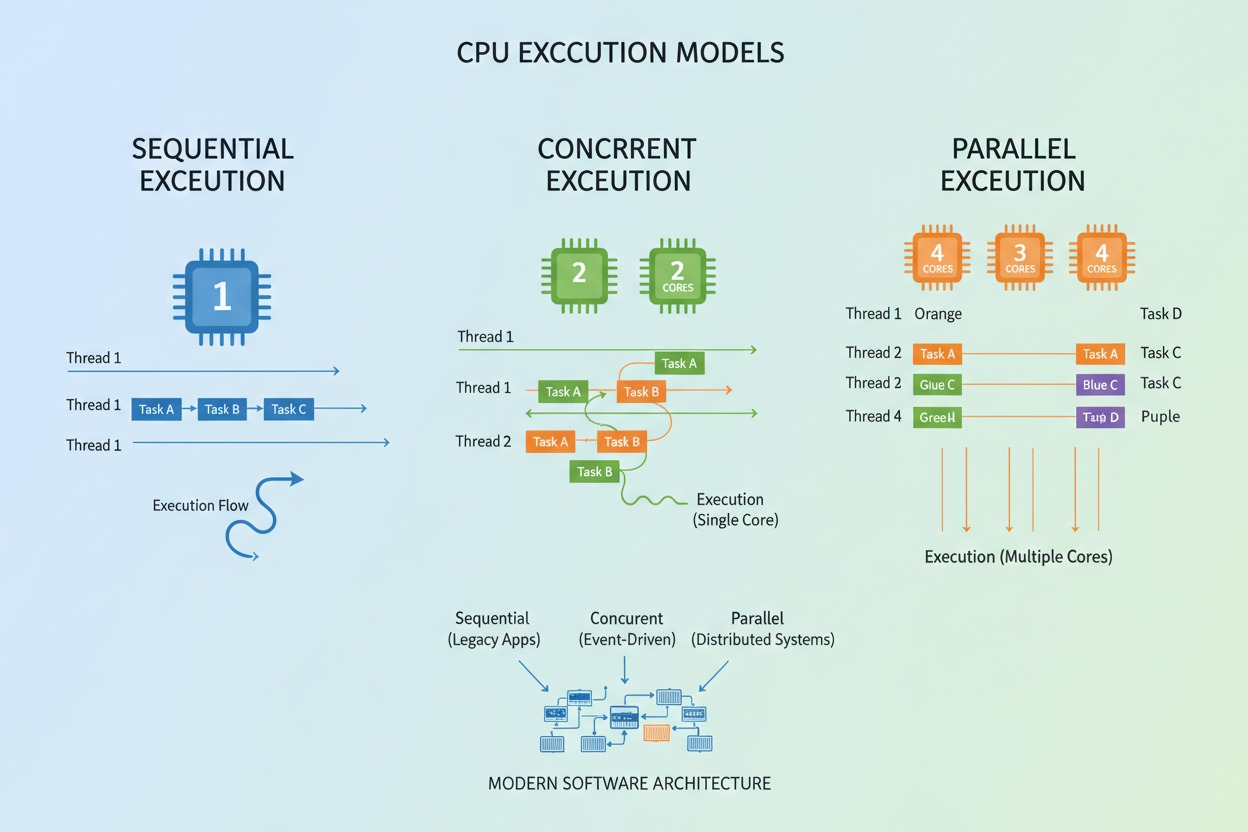
Sequential Execution
In sequential execution, tasks run one after another. Task B doesn’t start until Task A finishes. This is safe, predictable, and easy to reason about, but slow when tasks are independent of each other.
Task A: ████████
Task B:         ████████
Task C:                 ████████
Time ─────────────────────────────▶
Concurrent Execution
In concurrent execution, multiple tasks make progress during the same time period. On a single CPU core, the operating system rapidly switches between tasks (context switching), creating the illusion of parallelism. The tasks overlap in time, even though only one runs at any given instant.
Task A: ██  ██  ██
Task B:   ██  ██  ██
Time ─────────────────▶
Parallel Execution
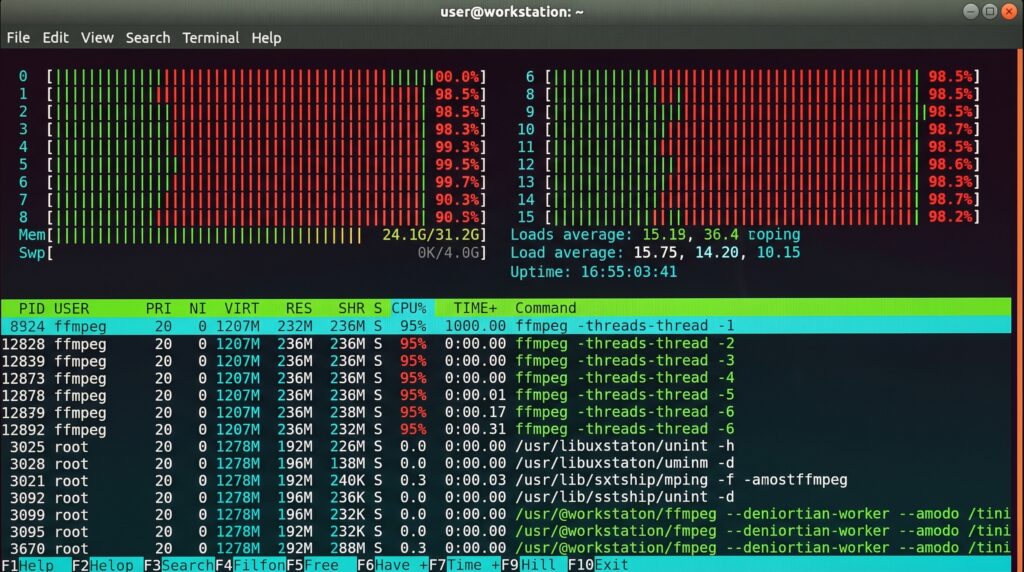
True parallelism requires multiple CPU cores. Tasks literally execute at the same physical instant on different hardware units. Modern servers routinely have 16, 32, or even 128 cores—making parallel execution the norm, not the exception.
Core 1: Task A ████████████
Core 2: Task B ████████████
Time ──────────────────────▶
Why Concurrency Exists
Concurrency exists because waiting is expensive. When your web server handles 10,000 requests per second, it can’t process them sequentially; the first user would finish before the last one even connected. Concurrency allows your application to handle I/O (network, disk), CPU computation, and background tasks simultaneously, dramatically improving throughput and user experience.
But concurrency introduces a fundamental challenge: shared state.
What Are Race Conditions?
A race condition occurs when two or more threads access shared data concurrently, and the final result depends on the order in which the accesses happen, an order you cannot control or predict.
Think of it like two people trying to update the same Google Doc simultaneously without real-time sync. Each person reads the current version, makes a change, and saves, but one person’s save overwrites the other’s, silently discarding their work.
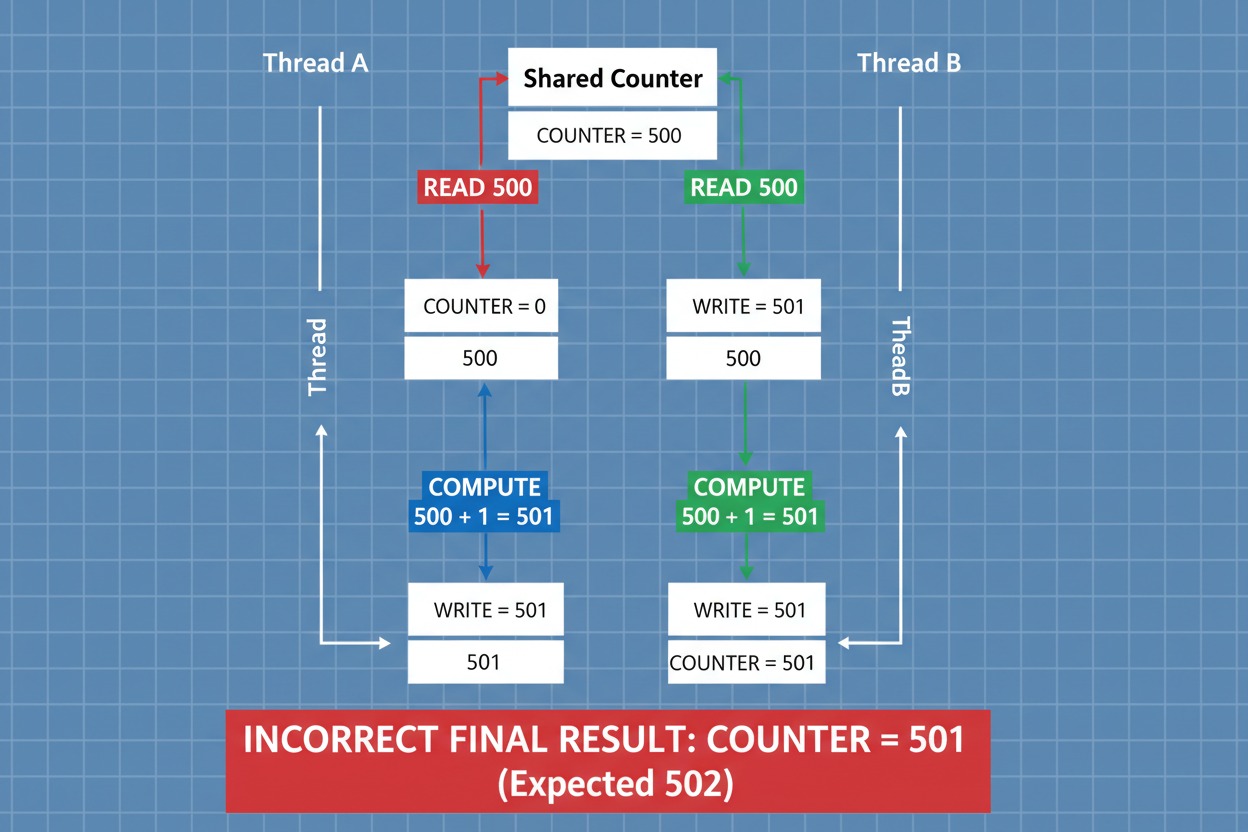
The core problem is the read-modify-write pattern:
- Thread reads a value
- Thread computes a new value
- Thread writes the new value back
If two threads execute this pattern concurrently on the same variable, their operations can interleave destructively.
Practical Example: Shared Counter
Here’s a classic demonstration in Python:
import threading

counter = 0
NUM_THREADS = 2
INCREMENTS_PER_THREAD = 1000

def increment():
    global counter
    for _ in range(INCREMENTS_PER_THREAD):
        counter += 1  # NOT atomic — this is 3 operations!

threads = [threading.Thread(target=increment) for _ in range(NUM_THREADS)]

for t in threads:
    t.start()
for t in threads:
    t.join()

print(f"Expected: {NUM_THREADS * INCREMENTS_PER_THREAD}")  # 2000
print(f"Actual:   {counter}")  # Likely something like 1734
Expected: counter = 2000
Actual: counter = 1734 (varies every run)
Why? Because, counter += 1 is not a single operation. Under the hood, it translates to:
LOAD  counter    → register
ADD   register, 1
STORE register   → counter
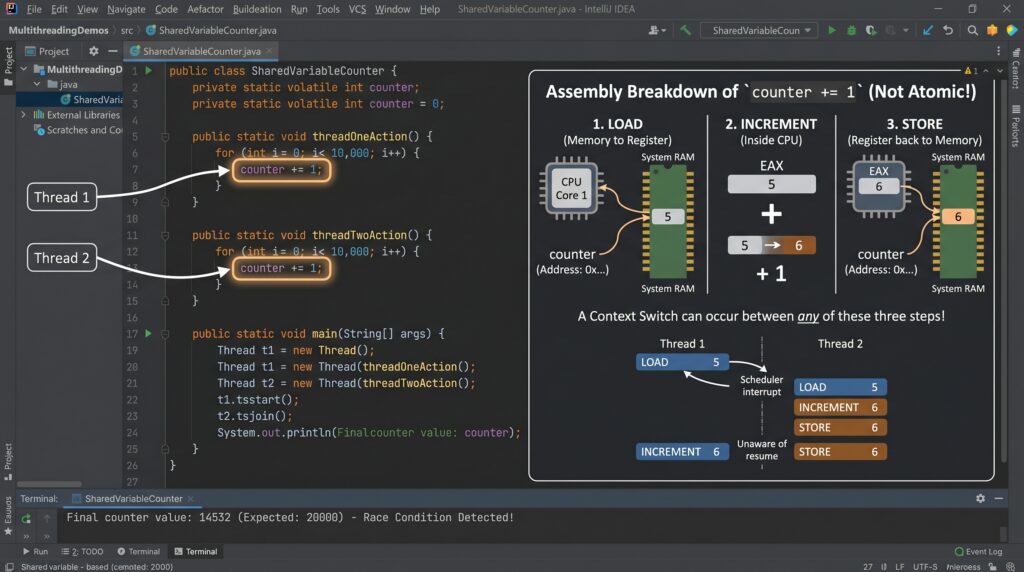
Two threads can both execute LOAD counter (getting the same value, say 500), both compute 501, and both stores 501—resulting in one increment instead of two. Multiply this across 1,000 iterations, and you lose a significant portion of your increments.
Understanding Thread Scheduling
To truly understand race conditions, you need to understand what the operating system is doing behind the scenes.
Context Switching
The OS scheduler gives each thread a small slice of CPU time (typically 1–10 milliseconds). When the slice expires, the scheduler pauses that thread (saving its registers and stack pointer), loads another thread’s state, and resumes it. This is called a context switch.
Context switches can happen at any instruction boundary, including between your LOAD, ADD, and STORE operations. This is what makes race conditions so insidious: they don’t happen every time, only when threads are switched at exactly the wrong moment.
Thread Interleaving
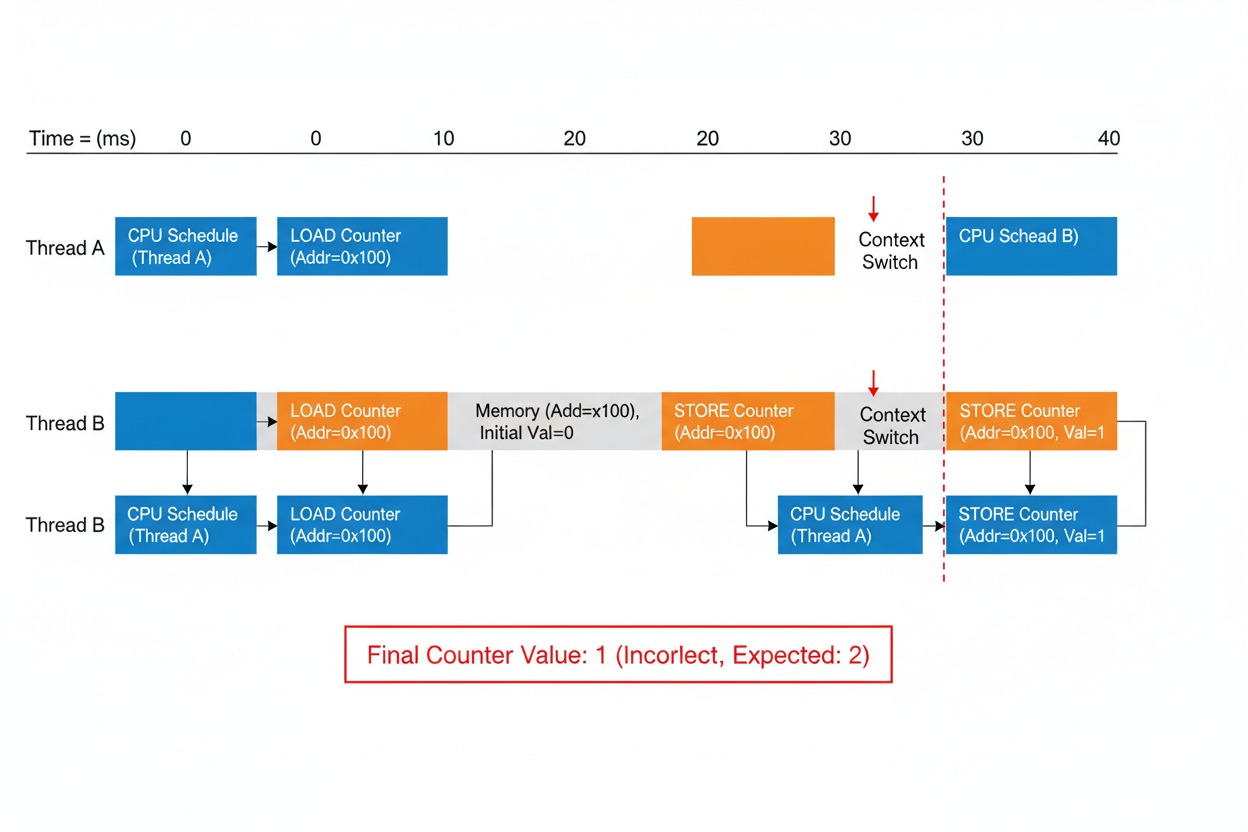
Consider two threads incrementing a counter from 0:
Time  Thread A                Thread B          counter
───────────────────────────────────────────────────────
t1    LOAD counter → reg_A                      0
t2    [context switch]
t3                            LOAD counter → reg_B  0
t4                            ADD reg_B, 1
t5                            STORE reg_B → counter  1
t6    [context switch]
t7    ADD reg_A, 1   (still 0!)
t8    STORE reg_A → counter                     1  ← wrong! should be 2
Both threads incremented, but the counter only went from 0 to 1. One increment was silently lost.
Preemption
The scheduler doesn’t ask permission before switching threads. Preemption means a running thread can be interrupted at any point. You have no guarantee that a logical sequence of operations in your code will execute atomically unless you explicitly enforce it.
Multi-Threading Challenges
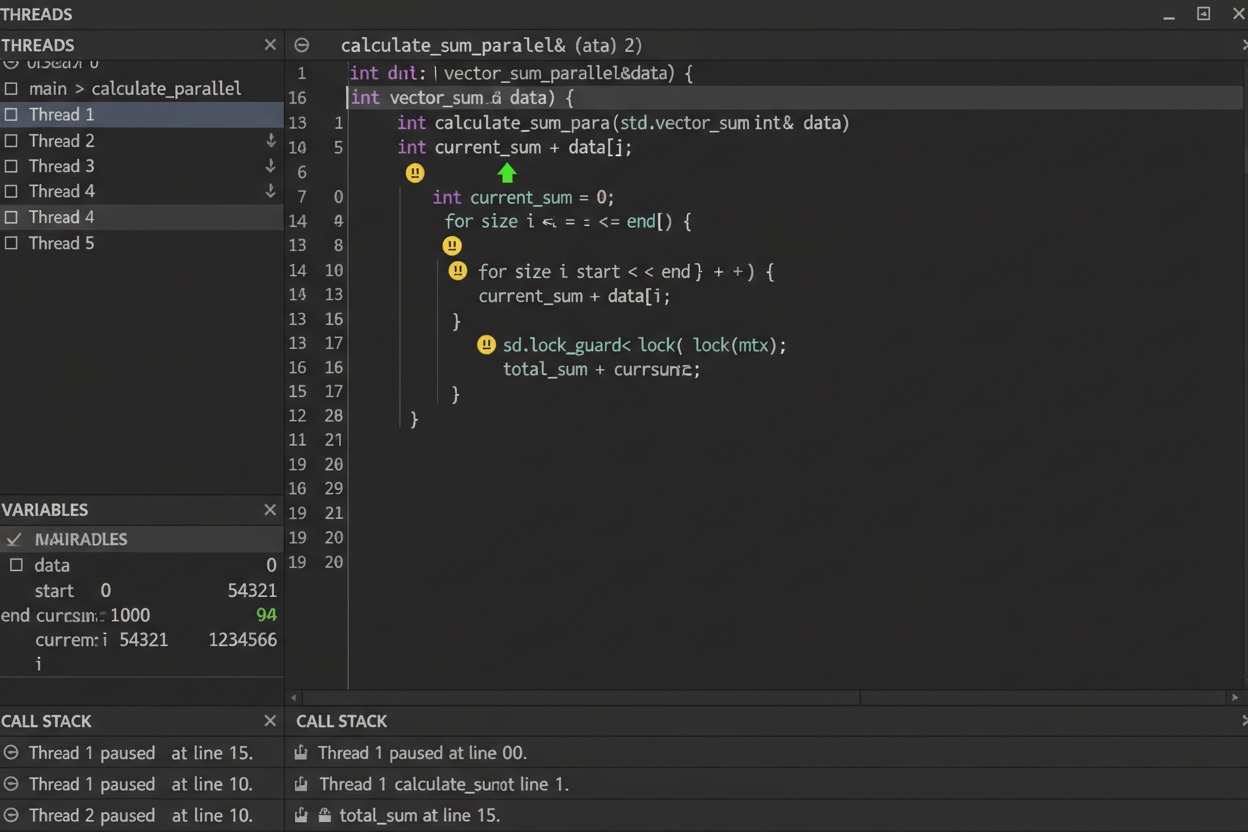
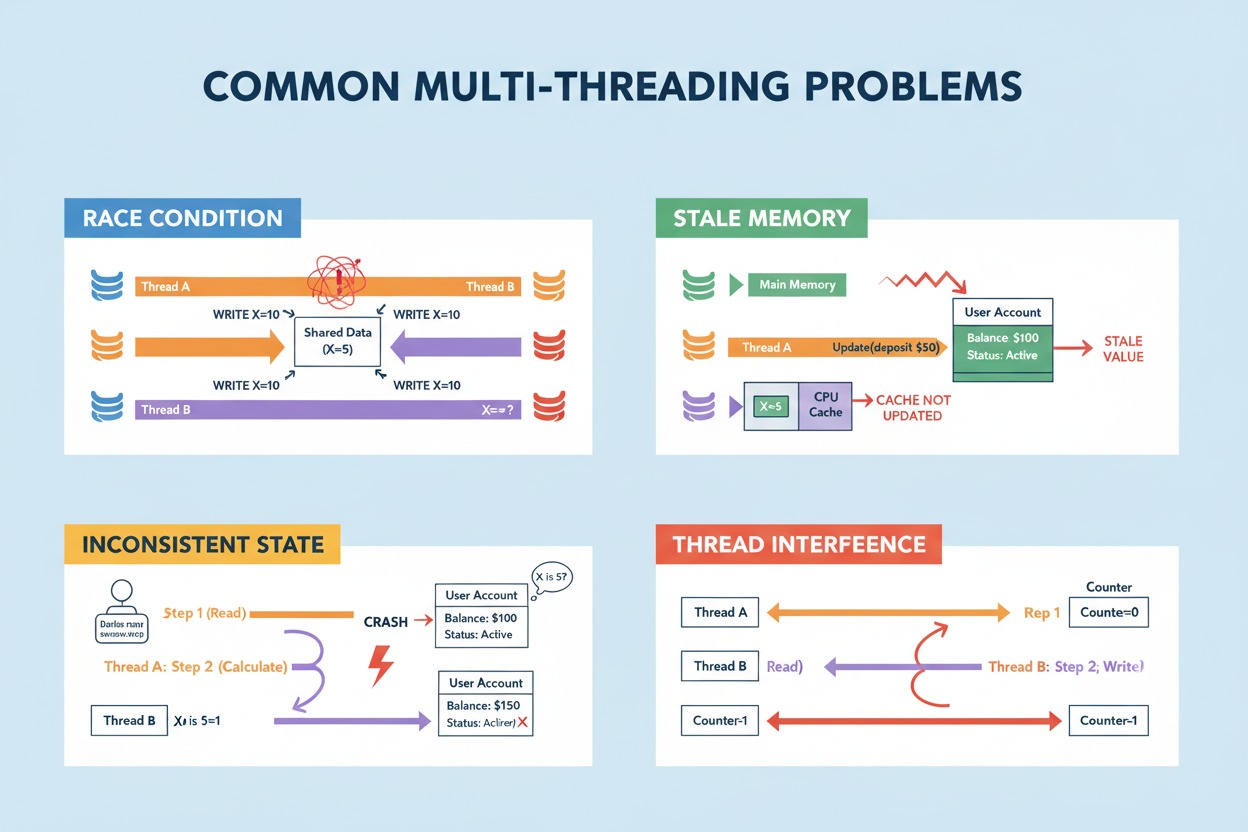
Race conditions are just one manifestation of a broader set of multi-threading hazards.
Shared State
Any variable, object, or resource accessed by more than one thread is shared state. The more shared state your application has, the more synchronization you need — and the more opportunities for bugs.
Data Corruption
When two threads write to the same memory location concurrently without synchronization, you get data corruption. In C/C++, this is undefined behavior. In managed languages, you get incorrect values. In databases, you get dirty reads and phantom writes.
Non-Deterministic Bugs
Race conditions produce different results on different runs, different machines, and different load levels. A test suite that passes 1,000 times may fail on run 1,001. This makes race conditions extraordinarily difficult to reproduce and diagnose.
Heisenbugs
Named after Heisenberg’s uncertainty principle, a heisenbug is a bug that disappears or changes behavior when you try to observe it. Adding print statements, attaching a debugger, or running under a profiler all change the timing of your threads and often make the race condition disappear. This gives developers false confidence that the bug is fixed.
def unsafe_withdraw(account, amount):
    if account.balance >= amount:
        # A heisenbug lives here.
        # Adding print("Checking balance...") CHANGES the timing
        # and can make the race condition vanish during debugging.
        account.balance -= amount
        return True
    return False
Memory Visibility Problems
On modern multi-core CPUs, each core has its own L1/L2 cache. When Thread A writes to a variable, Thread B on a different core may not see the updated value immediately — it’s reading from its own cache. This is called a stale read. Languages like Java address this with the volatile keyword; C++ uses std::atomic.
Cache Synchronization Issues
CPUs reorder memory operations for performance. The processor and compiler are both allowed to reorder reads and writes as long as the result is correct for a single thread. In a multi-threaded context, these reorderings can produce deeply counterintuitive behavior. Memory barriers and fences are the low-level primitives used to prevent harmful reorderings.
Real-World Example: Bank Account Transaction System
Let’s return to our banking scenario and build it out completely.
import threading
import time

class BankAccount:
    def __init__(self, balance):
        self.balance = balance

    def withdraw(self, amount, user):
        # Step 1: Check balance
        if self.balance >= amount:
            print(f"{user}: Balance is ${self.balance}. Withdrawing ${amount}...")
            time.sleep(0.01)  # Simulate processing delay
            # Step 2: Deduct amount
            self.balance -= amount
            print(f"{user}: Withdrawal successful. New balance: ${self.balance}")
            return True
        else:
            print(f"{user}: Insufficient funds. Balance: ${self.balance}")
            return False

account = BankAccount(1000)

# Both transactions run simultaneously
thread_a = threading.Thread(target=account.withdraw, args=(700, "User A"))
thread_b = threading.Thread(target=account.withdraw, args=(500, "User B"))

thread_a.start()
thread_b.start()
thread_a.join()
thread_b.join()

print(f"\nFinal balance: ${account.balance}")
# Output: Final balance: $-200
What happens step by step:
| Time | User A | User B | Balance |
|---|---|---|---|
| t1 | Checks: $1000 ≥ $700 ✓ | $1000 | |
| t2 | Checks: $1000 ≥ $500 ✓ | $1000 | |
| t3 | Deducts $700 | $300 | |
| t4 | Deducts $500 | -$200 |
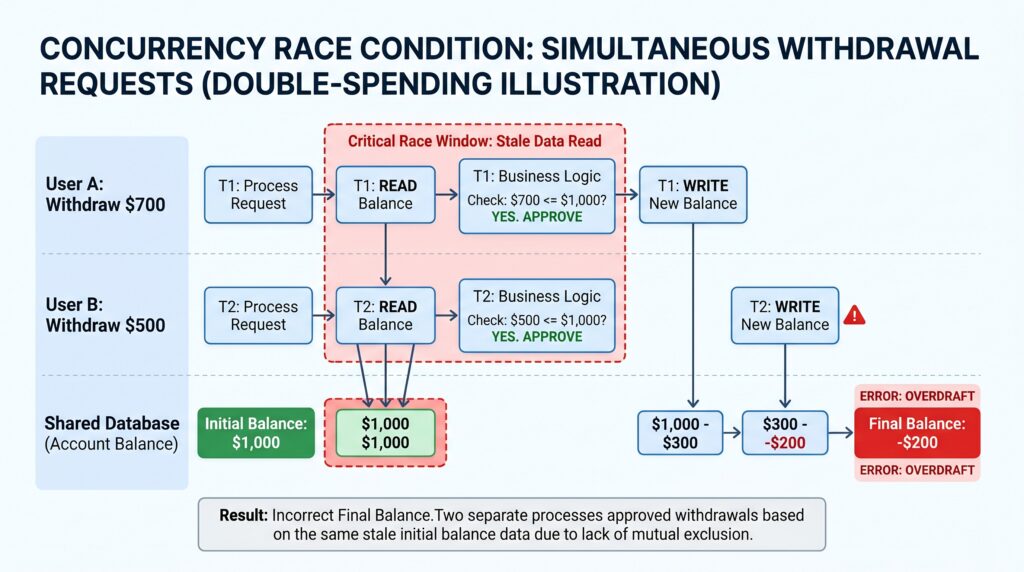
Both threads passed the balance check before either was deducted. The check and the deduction are not atomic; they’re two separate operations with a gap between them where disaster can strike.

Fixing the Race Condition
The fix requires making the check-and-deduct sequence atomic, meaning it executes as a single, indivisible unit.
Unsafe Implementation (The Problem)
# UNSAFE: Race condition between check and deduct
def withdraw_unsafe(self, amount):
    if self.balance >= amount:   # <-- Thread can be preempted here
        self.balance -= amount   # <-- Another thread modifies balance before we get here
        return True
    return False
Safe Implementation (The Fix)
import threading

class SafeBankAccount:
    def __init__(self, balance):
        self.balance = balance
        self._lock = threading.Lock()  # One mutex per account

    def withdraw(self, amount, user):
        with self._lock:  # Only ONE thread can enter this block at a time
            if self.balance >= amount:
                self.balance -= amount
                print(f"{user}: Withdrew ${amount}. Balance: ${self.balance}")
                return True
            else:
                print(f"{user}: Insufficient funds.")
                return False
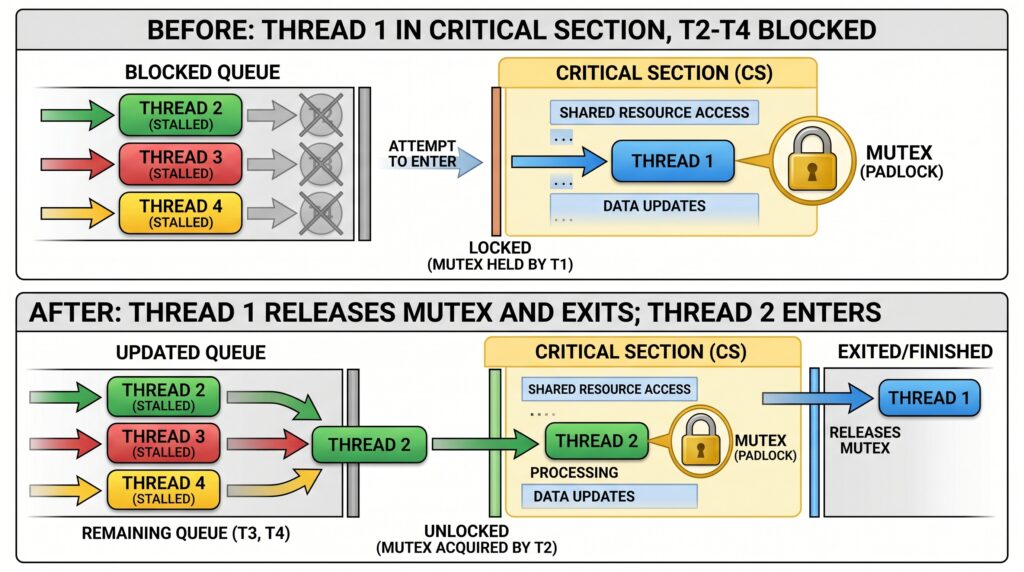
The with self._lock: block is the critical section, the region of code that accesses shared state. The lock guarantees that only one thread executes this block at a time. If Thread B arrives while Thread A holds the lock, Thread B waits until Thread A releases it.

Mutexes and Locks
A mutex (mutual exclusion lock) is the fundamental synchronization primitive. It ensures that only one thread can access a protected resource at a time.
How Mutexes Work
—twoA mutex has two states: locked and unlocked. The key guarantee is that the lock acquisition is atomic—two threads cannot both successfully acquire the same mutex simultaneously.
Thread A: acquire_lock() → SUCCESS → [critical section] → release_lock()
Thread B: acquire_lock() → BLOCKS  → (waiting...)       → acquire_lock() → SUCCESS
Python Example
import threading

lock = threading.Lock()

def thread_safe_increment():
    global counter
    with lock:          # Equivalent to: lock.acquire() ... lock.release()
        counter += 1    # Now atomic with respect to other threads using this lock
Java Example
public class SafeCounter {
    private int count = 0;
    private final Object lock = new Object();

    public void increment() {
        synchronized(lock) {   // Java's built-in mutex
            count++;
        }
    }

    public int getCount() {
        synchronized(lock) {
            return count;
        }
    }
}
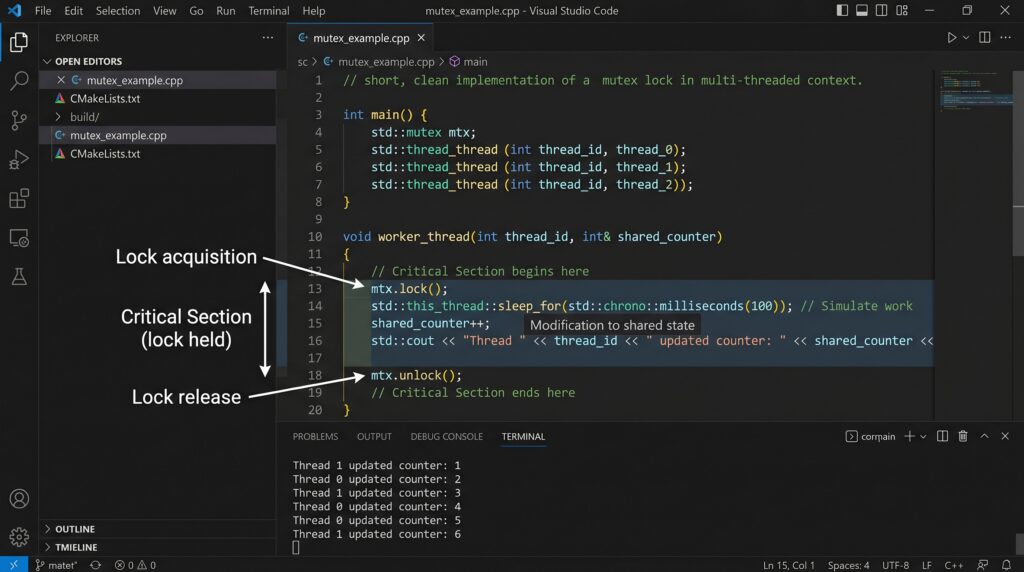
C++ Example
#include <mutex>
#include <thread>

std::mutex mtx;
int counter = 0;

void increment() {
    for (int i = 0; i < 1000; ++i) {
        std::lock_guard<std::mutex> guard(mtx);  // RAII: auto-releases on scope exit
        counter++;
    }
}
The RAII pattern in C++ (lock_guard) is particularly important: the lock is automatically released when the guard goes out of scope, even if an exception is thrown.
Deadlocks Explained
Mutexes solve race conditions, but they introduce a new hazard: deadlocks.
A deadlock occurs when two or more threads are each waiting for a resource held by the other, creating a cycle where none can proceed. Both threads are stuck forever (or until your application crashes, times out, or is killed).
Classic Deadlock Scenario
import threading

lock_a = threading.Lock()
lock_b = threading.Lock()

def thread_1():
    with lock_a:              # Acquires Lock A
        print("Thread 1: holding A, waiting for B...")
        with lock_b:          # Waits for Lock B (held by Thread 2)
            print("Thread 1: got both locks!")

def thread_2():
    with lock_b:              # Acquires Lock B
        print("Thread 2: holding B, waiting for A...")
        with lock_a:          # Waits for Lock A (held by Thread 1)
            print("Thread 2: got both locks!")

t1 = threading.Thread(target=thread_1)
t2 = threading.Thread(target=thread_2)
t1.start()
t2.start()
# Program hangs forever
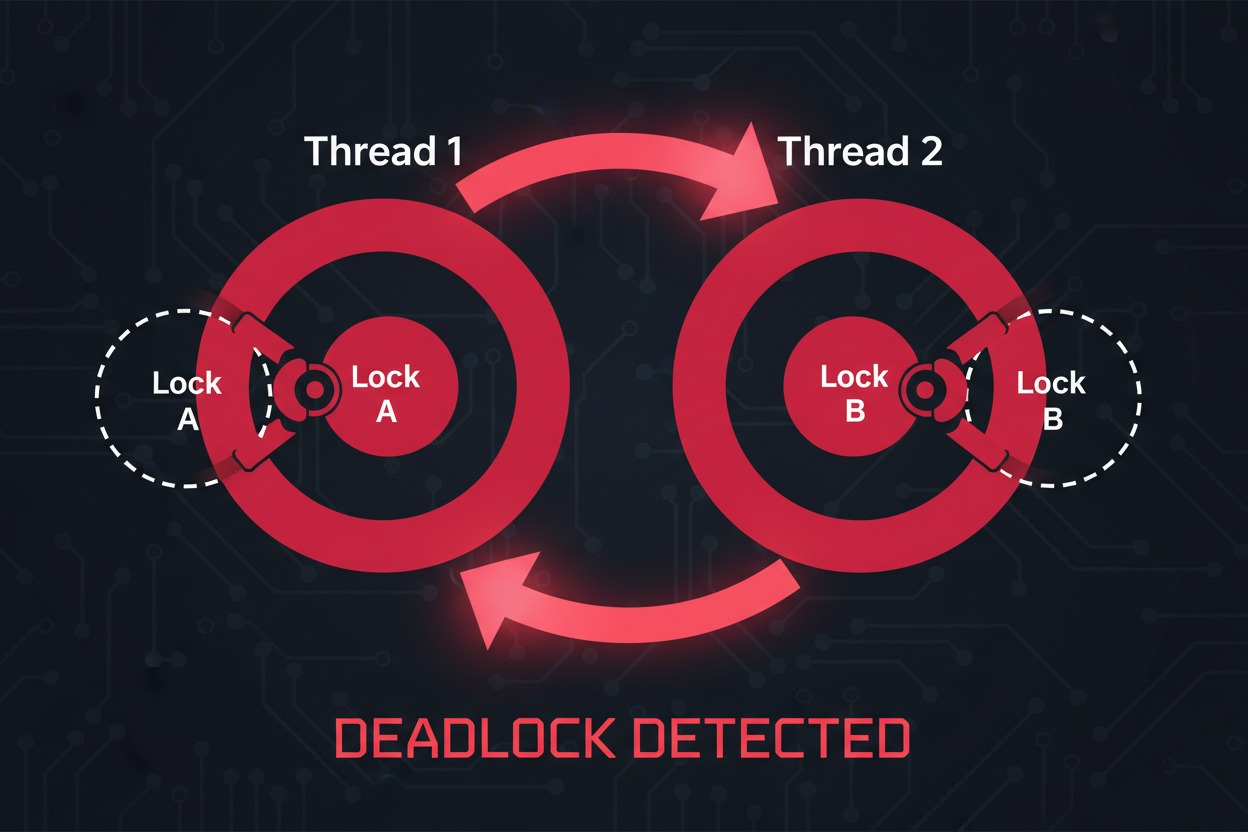
Thread 1: Holds Lock A → Waits for Lock B
Thread 2: Holds Lock B → Waits for Lock A
Result:   Neither can proceed. DEADLOCK.
The Four Conditions Required for Deadlocks
Deadlocks require all four of these conditions simultaneously (the Coffman conditions). Eliminate anyone, and deadlocks become impossible.
1. Mutual Exclusion — Resources cannot be shared; only one thread can hold a lock at a time. (This is often necessary for correctness.)
2. Hold and Wait — A thread holds at least one resource while waiting to acquire additional resources held by other threads.
# Violates Hold-and-Wait prevention:
# Instead of acquiring locks one at a time, acquire all at once
def thread_safe(lock_a, lock_b):
    # Python's contextlib or sorted lock ordering prevents this
    with acquire_all(lock_a, lock_b):
        pass  # Safe: either you get both or neither
3. No Preemption — A lock cannot be forcibly taken from a thread; it must be voluntarily released.
4. Circular Wait — Thread A waits for Thread B, which waits for Thread A (or a longer cycle).
Prevention strategy: Establish a global lock ordering. If every thread always acquires Lock A before Lock B (never the reverse), circular waits become impossible.
# Always sort locks by id() before acquiring — eliminates circular wait
def safe_transfer(account_from, account_to, amount):
    first, second = sorted([account_from._lock, account_to._lock], key=id)
    with first:
        with second:
            account_from.balance -= amount
            account_to.balance += amount

Other Synchronization Techniques
Mutexes are the workhorse, but concurrency has a rich toolkit.
Semaphores
A semaphore maintains an integer counter. acquire() decrements it (blocking if zero); release() increments it. While a mutex allows exactly one thread, a semaphore can allow N threads simultaneously, useful for rate limiting or resource pooling.
import threading

# Allow at most 3 concurrent database connections
db_semaphore = threading.Semaphore(3)

def query_database():
    with db_semaphore:  # Blocks when 3 connections are already active
        # perform DB query
        pass
Read-Write Locks
When reads vastly outnumber writes, a standard mutex is wasteful — reads don’t conflict with each other. A read-write lock allows multiple concurrent readers but exclusive access for writers.
import threading

rw_lock = threading.RLock()  # Python's reentrant lock; use rwlock package for true RW locks

# Multiple threads can read concurrently
# Writer gets exclusive access
Atomic Operations
For simple operations like incrementing a counter, full mutex locking is expensive. Atomic operations are hardware-guaranteed to be indivisible — no thread can observe a partial state.
from multiprocessing import Value
import ctypes

# Atomic counter using shared memory
counter = Value(ctypes.c_int, 0)

def atomic_increment():
    with counter.get_lock():
        counter.value += 1
In Java, java.util.concurrent.atomic.AtomicInteger provides lock-free atomic arithmetic.
Condition Variables
Condition variables let threads sleep until a specific condition becomes true, avoiding busy-waiting.
import threading

buffer = []
condition = threading.Condition()

def producer():
    with condition:
        buffer.append("data")
        condition.notify()  # Wake up waiting consumer

def consumer():
    with condition:
        while not buffer:
            condition.wait()  # Sleep until notified
        item = buffer.pop()
Monitors
A monitor combines a mutex and condition variables into a single construct. Java’s synchronized Keyword “implements” the monitor pattern, every object has an implicit monitor.

Debugging Concurrency Problems
Concurrency bugs are notoriously hard to reproduce. Here’s a systematic approach.
Logging and Timestamps
Add thread-aware logging with high-resolution timestamps. Log the thread ID alongside every operation on shared state.
import logging
import threading
import time

logging.basicConfig(
    format='%(asctime)s.%(msecs)03d [%(threadName)s] %(message)s',
    datefmt='%H:%M:%S',
    level=logging.DEBUG
)

def withdraw(account, amount):
    logging.debug(f"Checking balance: ${account.balance}")
    # ...
    logging.debug(f"Withdrawal complete. New balance: ${account.balance}")
Thread Dumps
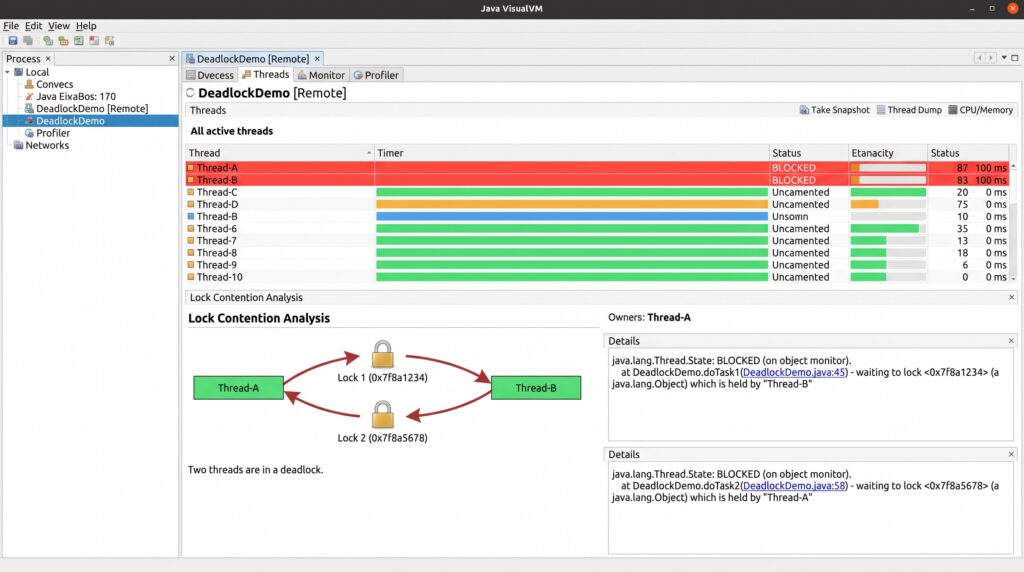
In Java, jstack <pid> produces a full thread dump showing every thread’s state and call stack. Look for threads in BLOCKED stake—that’s your deadlock.
# Java thread dump
jstack $(pgrep -f MyApplication) > thread_dump.txt
grep -A 20 "BLOCKED" thread_dump.txt
Stress Testing
Race conditions often require specific timing to manifest. Run your concurrent code under heavy load:
# Run test with 32 threads, 10,000 iterations
python -m pytest tests/test_concurrency.py -n 32 --count=10000
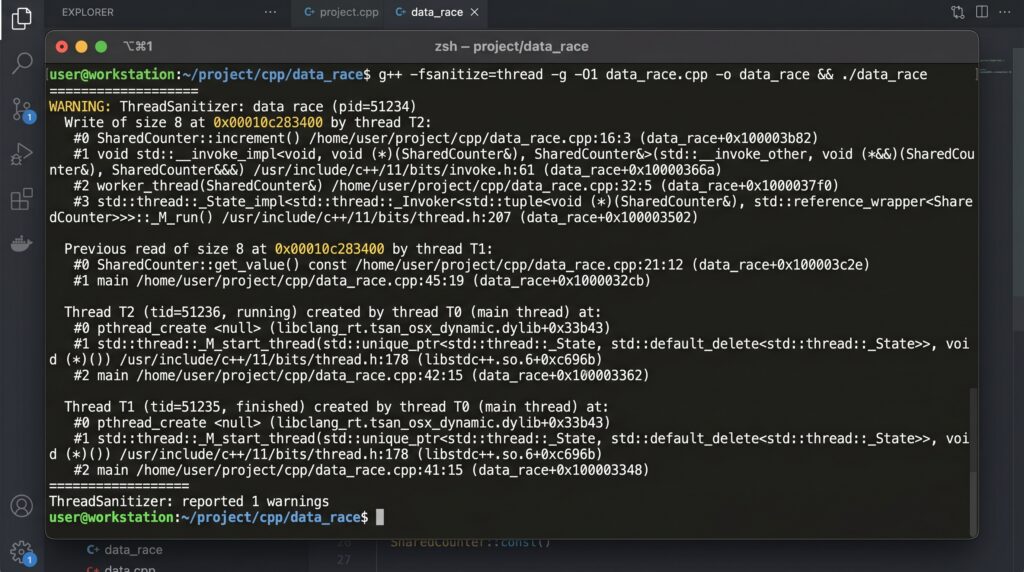
ThreadSanitizer (TSan)
Google’s ThreadSanitizer is a compile-time instrumentation tool for C/C++ and Go that detects data races at runtime with high accuracy.
# Compile with ThreadSanitizer
gcc -fsanitize=thread -g -O1 myprogram.c -o myprogram
./myprogram
# TSan output:
# WARNING: ThreadSanitizer: data race on counter
#   Write of size 4 at 0x... by thread T2:
#     #0 increment() myprogram.c:12
#   Previous read of size 4 at 0x... by thread T1:
#     #0 increment() myprogram.c:12
Helgrind / Valgrind
For programs already compiled, Helgrind (part of Valgrind) instruments the binary at runtime:
valgrind --tool=helgrind ./myprogram
Java VisualVM
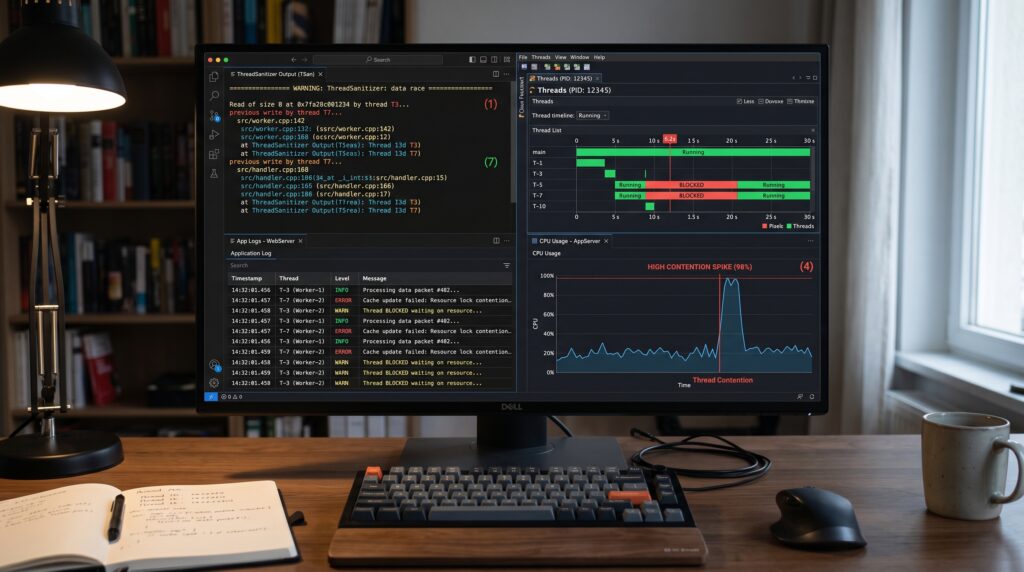
Java VisualVM provides a GUI showing thread states, CPU usage, and heap activity in real time. Use it to spot threads stuck in BLOCKED/WAITING states during load testing.
Best Practices for Thread Safety
Minimize Shared State
The safest shared resource is one that doesn’t exist. Design your systems to keep state local to threads where possible. Prefer message passing (queues, channels) over shared memory.
from queue import Queue

task_queue = Queue()

def worker():
    while True:
        task = task_queue.get()  # Blocking, thread-safe get
        process(task)
        task_queue.task_done()
Use Immutable Objects
An object that cannot be modified after creation is inherently thread-safe. No synchronization needed.
from dataclasses import dataclass

@dataclass(frozen=True)  # frozen=True makes it immutable
class Money:
    amount: float
    currency: str

# Safe to share across threads — no one can modify it
USD_100 = Money(100.0, "USD")
Prefer Atomic Operations
For counters, flags, and simple state, use atomic primitives instead of full locks. They’re faster and harder to misuse.
// Java: Lock-free thread-safe counter
AtomicInteger counter = new AtomicInteger(0);
counter.incrementAndGet();  // Atomic, no lock needed
Consistent Lock Ordering
As shown in the deadlock section, always acquire multiple locks in the same global order to prevent circular waits.
Avoid Nested Locks
Nested locks dramatically increase deadlock risk. If you must nest, document, and enforce the ordering rigorously.
Keep Critical Sections Small
Hold locks for the minimum time necessary. Move I/O, heavy computation, and anything that could block outside the critical section.
# Bad: Lock held during slow I/O
with lock:
    data = fetch_from_database()  # Slow! Lock held for seconds
    process(data)

# Good: Compute first, lock only for the update
data = fetch_from_database()  # No lock needed for reading
with lock:
    shared_cache[key] = data    # Lock held for microseconds
Use Thread-Safe Collections
Standard collections are usually not thread-safe. Use purpose-built alternatives:
from queue import Queue        # Thread-safe FIFO
from collections import deque  # Not thread-safe for multi-producer
import queue
q = queue.Queue()              # Safe for multi-producer, multi-consumer

# Java equivalents
# ConcurrentHashMap, CopyOnWriteArrayList, LinkedBlockingQueue
Test Under Load
Concurrency bugs don’t reveal themselves under light load. Use tools like Apache JMeter, Locust, or Go’s race detector to stress-test at scale.
# Go race detector — catches races at runtime during tests
go test -race ./...

Performance Considerations
Synchronization isn’t free. Understanding the performance tradeoffs helps you choose the right tool.
Lock Contention
When many threads compete for the same lock, most are waiting rather than working. This lock contention can make your multi-threaded application slower than a single-threaded one.
Throughput comparison (illustrative):
No sync (unsafe):    ████████████████████  ~5M ops/sec
Atomic operations:   ████████████████      ~4M ops/sec  (5-20% overhead)
Mutex (low cont.):   ████████████          ~3M ops/sec  (40% overhead)
Mutex (high cont.):  ████                  ~1M ops/sec  (80% overhead)
Scalability Bottlenecks
Amdahl’s Law states that the speedup from parallelization is limited by the sequential fraction of your code. A function that holds a global lock for 20% of its execution time can never achieve more than 5× speedup regardless of how many CPU cores you add.
Strategies for Reducing Contention
Sharding: Instead of a single global lock, use multiple locks across different partitions of your data. Java’s ConcurrentHashMap uses 16 independent lock segments.
# Sharded counter: 16 independent counters, reduced contention
class ShardedCounter:
    NUM_SHARDS = 16

    def __init__(self):
        self.shards = [0] * self.NUM_SHARDS
        self.locks = [threading.Lock() for _ in range(self.NUM_SHARDS)]

    def increment(self, thread_id):
        shard = thread_id % self.NUM_SHARDS
        with self.locks[shard]:
            self.shards[shard] += 1

    def total(self):
        return sum(self.shards)  # Approximate; reading without locks for performance
Lock-free data structures: Advanced data structures using compare-and-swap (CAS) operations eliminate locks entirely, at the cost of implementation complexity.

Frequently Asked Questions
Q: What is a race condition?
A race condition is a bug where program behavior depends on the relative timing of concurrent operations. It occurs when multiple threads access shared mutable state without proper synchronization, producing incorrect results that vary between executions.
Q: What causes a deadlock?
A deadlock requires four simultaneous conditions: mutual exclusion (resources can’t be shared), hold-and-wait (threads hold resources while waiting for others), no preemption (resources can’t be forcibly taken), and circular wait (a cycle of threads each waiting for another). Eliminating anyone prevents deadlock.
Q: How does a mutex work?
A mutex maintains a binary locked/unlocked state. When a thread calls lock(), it either acquires the mutex (if unlocked) or blocks until it’s available. Only the holding thread can call unlock(). The acquisition is guaranteed to be atomic by the hardware.
Q: What’s the difference between a mutex and a semaphore?
A mutex is binary (locked/unlocked) and must be released by the thread that acquired it; it’s for mutual exclusion. A semaphore has an integer counter and can be signaled by any thread, it’s for controlling access to a pool of N resources or for thread signaling.
Q: What are atomic operations?
Atomic operations are single, indivisible hardware operations that complete without interruption. Common examples: compare-and-swap (CAS), fetch-and-add, and test-and-set. They enable lock-free synchronization for simple data structures and counters.
Q: How do you debug concurrency bugs?
Start with thread-aware logging to capture ordering. Use stress tests with high thread counts and iteration counts to increase the probability of reproducing the bug. Apply static analysis and runtime detectors (ThreadSanitizer, Helgrind). Take thread dumps when threads appear stuck (deadlock). If the bug is a heisenbug that disappears under a debugger, add lightweight logging instead.
Conclusion
Race conditions and concurrency bugs are among the most challenging problems in software engineering, not because the concepts are complicated, but because the bugs are invisible, intermittent, and often devastating in production.
Here’s what you need to remember:
Race conditions occur when multiple threads access shared mutable state without synchronization, and the result depends on who gets there first. The read-modify-write pattern is the primary culprit.
Mutexes protect critical sections by ensuring only one thread executes them at a time. They’re the most common and versatile synchronization primitive, but they come with a performance cost and must be used carefully.
Deadlocks are what happen when threads hold locks while waiting for other locks, creating a cycle that no thread can escape. Prevent them by establishing consistent lock ordering and minimizing lock nesting.
Atomics, semaphores, and read-write locks each have their place: atomics for simple counters and flags, semaphores for resource pooling, and read-write locks for read-heavy workloads.
For production systems, the actionable advice is clear: minimize shared state, prefer immutable data, keep critical sections small, and test under realistic concurrent load. Invest in tooling: ThreadSanitizer, Helgrind, and VisualVM exist precisely because human review of concurrent code is notoriously unreliable.
Concurrency is hard. But with the right mental model, the right primitives, and the right tooling, it’s absolutely conquerable.
Nice post, thanks for sharing!
Great article, very useful.
I learned something new today.
Good information, appreciate it.
Very helpful content, thanks!