Designing a Payment System: Challenges and Solutions
A customer clicks “Pay Now.” Within two seconds, money moves between banks, a fraud engine evaluates hundreds of signals, databases record the transaction, and a notification lands in an inbox. The customer sees a spinner. What happens underneath is one of the most demanding engineering problems in software.
Payment systems are where software meets legal tender. Unlike a social media feed where a missed post is a nuisance, a missed payment or a double charge can trigger chargebacks, regulatory scrutiny, and a loss of customer trust that takes years to rebuild. The engineering teams behind Stripe, Adyen, and Braintree did not arrive at their architectures by accident — they evolved them through outages, fraud attacks, and the slow accumulation of hard lessons.
This guide distills those lessons into a practical architecture reference. Whether you are building a payments feature in a startup or interviewing for a senior engineering role at a payments company, what follows will give you a concrete, honest picture of how these systems are designed, why they fail, and how to make them resilient.
1. What Is a Payment System?
A payment system is the combination of software, hardware, protocols, and institutional relationships that allows value to move from one party to another electronically. For the purposes of this article, we focus on card-based online payments — the type that powers e-commerce, SaaS subscriptions, and in-app purchases.
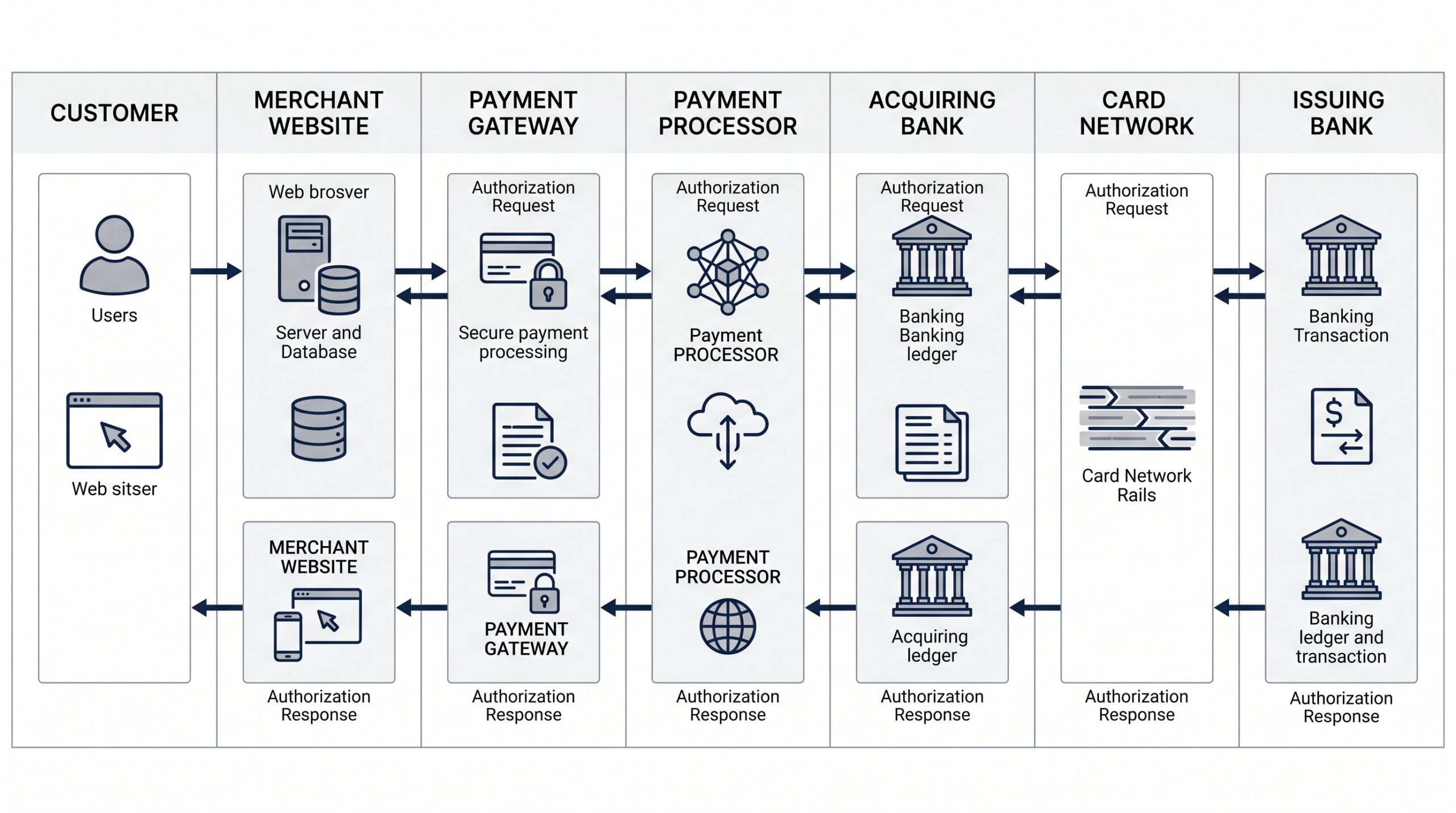
Understanding the architecture starts with understanding the actors involved. A single “Pay Now” click can involve six distinct parties:
| Actor | Role | Example |
|---|---|---|
| Customer | Initiates the payment by providing card or wallet credentials | End user on a checkout page |
| Merchant | The business receiving payment for goods or services | An e-commerce store |
| Payment Gateway | The API surface that accepts payment requests, encrypts card data, and routes to the processor | Stripe, Adyen, Braintree |
| Payment Processor | Communicates with card networks and banks to authorize and settle funds | Worldpay, Elavon, TSYS |
| Acquiring Bank | The merchant’s bank; receives funds on the merchant’s behalf | JPMorgan Chase (merchant account) |
| Card Network | Routes authorization requests between the acquiring and issuing banks; sets interchange rules | Visa, Mastercard, Amex |
| Issuing Bank | The customer’s bank; approves or declines the charge and debits the customer’s account | Bank of America, Citi |
Each of these parties communicates over a mix of modern REST APIs and legacy ISO 8583 messaging protocols. The fact that a real-time authorization can traverse this chain in under two seconds is a quiet engineering marvel.
2. End-to-End Transaction Flow
Walk through the nine stages of a single payment to understand what can go wrong at each step.
- Customer submits payment. The browser (or mobile SDK) collects card details and POSTs them to the payment gateway’s JavaScript library or API endpoint — never to your own server directly. This is the first security boundary.
- Merchant creates a payment intent. Your backend creates a payment record with a unique transaction ID before initiating the charge. This record acts as your source of truth regardless of what happens downstream.
- Gateway validates the request. The gateway checks field formats, currency codes, and merchant account status. A malformed request is rejected here with a 4xx response before any bank communication occurs.
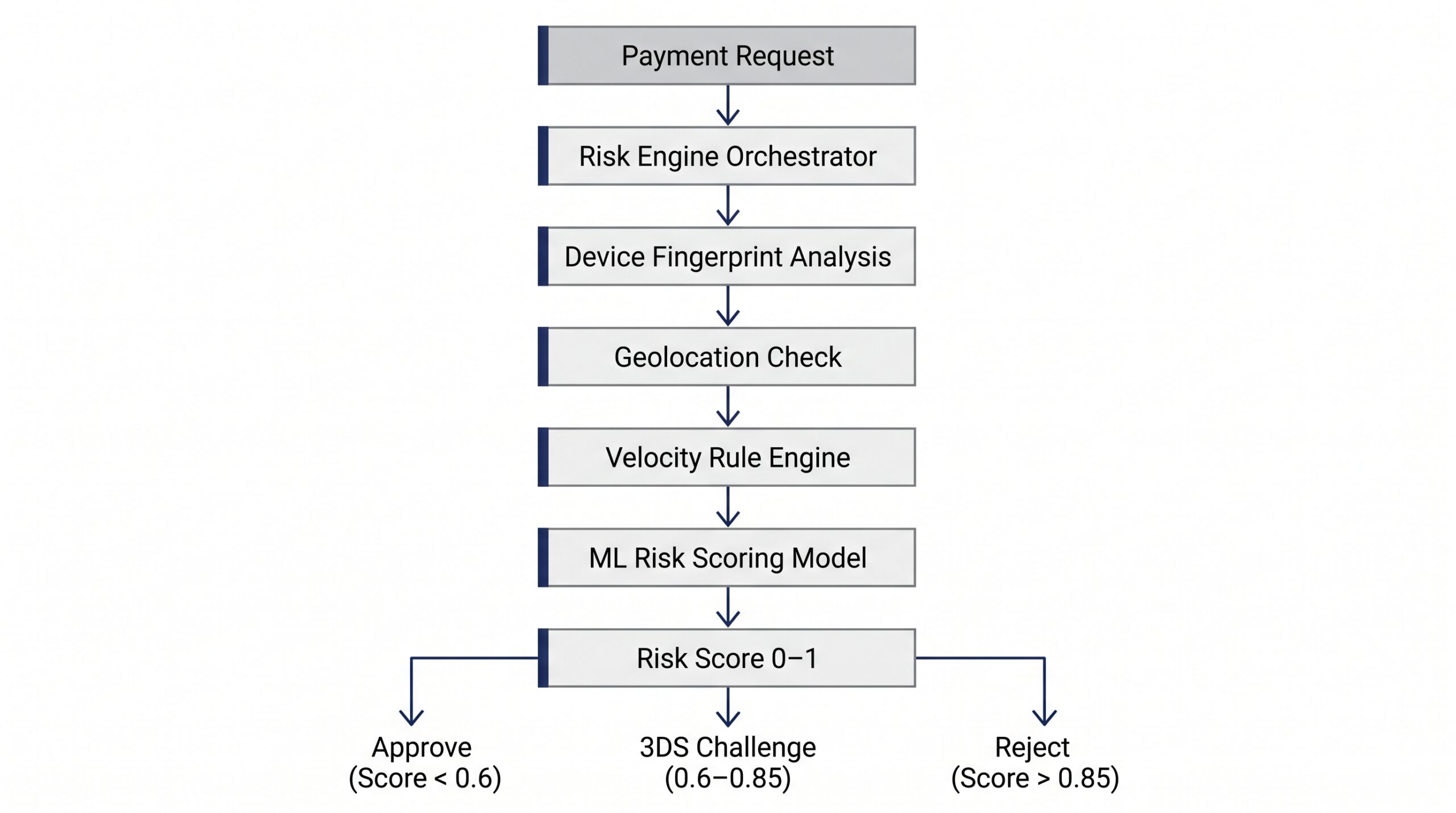
- Fraud screening. The gateway’s fraud engine evaluates the transaction against velocity rules, device fingerprints, and IP geolocation. High-risk transactions are declined or flagged for 3D Secure authentication.
- Processor routing. The processor receives a clean authorization request and routes it to the correct card network based on the card’s BIN (Bank Identification Number).
- Bank authorization. The issuing bank checks the customer’s available balance, applies its own fraud rules, and returns an authorization code or a decline reason code (such as insufficient funds or card blocked).
- Response handling. The authorization response travels back through the processor and gateway to your application. Your backend updates the payment record and returns a result to the customer UI.
- Capture and settlement. Authorization reserves funds; capture instructs the bank to actually move money. Many systems authorize and capture simultaneously (auth-capture), but subscriptions often separate them. Settlement batches typically run overnight.
- Merchant notification. Webhooks fire to notify your system of confirmed captures, declines, refunds, and disputes. Your application updates order state and triggers downstream workflows.
3. Payment Gateway Architecture
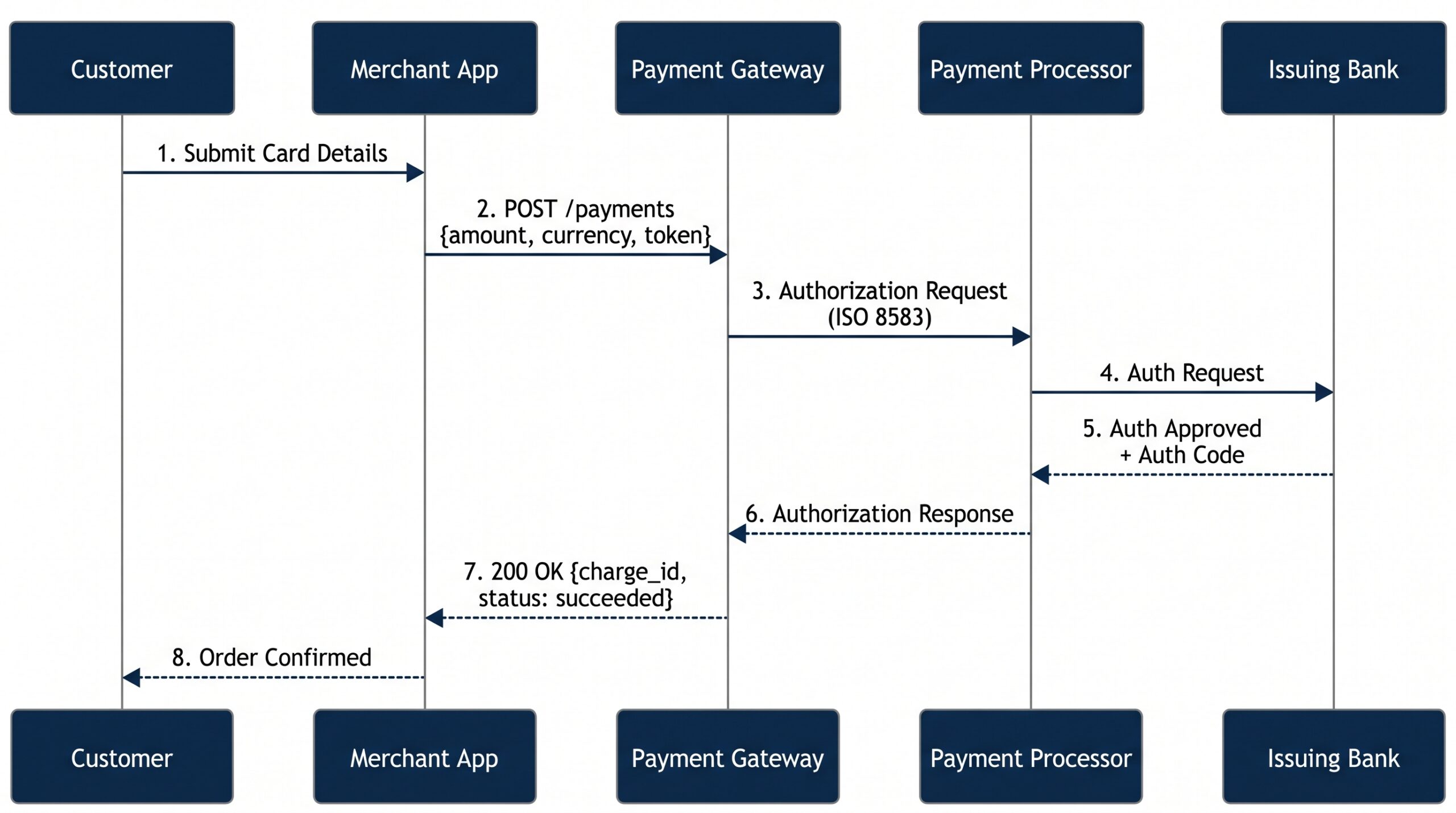
The gateway is the most visible piece of payment infrastructure for application engineers. Its responsibilities go well beyond proxying a network request.
What a Gateway Actually Does
- Tokenization: Replaces raw card numbers (PANs) with non-sensitive tokens stored in a vault. Your database never holds card data.
- Encryption: Card data is encrypted at the point of entry (browser or SDK) and never touches your servers in plaintext.
- Request validation: Validates currency, amount precision, card expiry, and CVV format before routing.
- Smart routing: Routes transactions to the processor with the highest authorization rate for that card type, reducing declines.
- PCI DSS scope reduction: By delegating card handling to the gateway, merchants dramatically shrink their PCI audit scope.
Example Payment Request
{
  "amount": 5000,
  "currency": "USD",
  "customer_id": "cust_abc123",
  "payment_method": "pm_tok_visa4242",
  "idempotency_key": "order_789_attempt_1",
  "metadata": {
    "order_id": "order_789",
    "product": "Annual Subscription"
  }
}| Field | Type | Notes |
|---|---|---|
amount | integer | Always in the smallest currency unit (cents). Never use floats for money. |
currency | string | ISO 4217 currency code. Required for multi-currency routing. |
customer_id | string | Links the charge to a stored customer and their saved payment methods. |
payment_method | string | A gateway token — never a raw card number. |
idempotency_key | string | Prevents duplicate charges on retry. See Section 5. |
metadata | object | Freeform key-value pairs for reconciliation. Not visible to the customer. |
One subtle point: always store the gateway’s returned charge_id alongside your own order_id immediately after receiving a response. If your database write fails after a successful charge, you need that ID to query the gateway and reconcile the discrepancy without risking a second charge.
4. Handling Webhooks Correctly
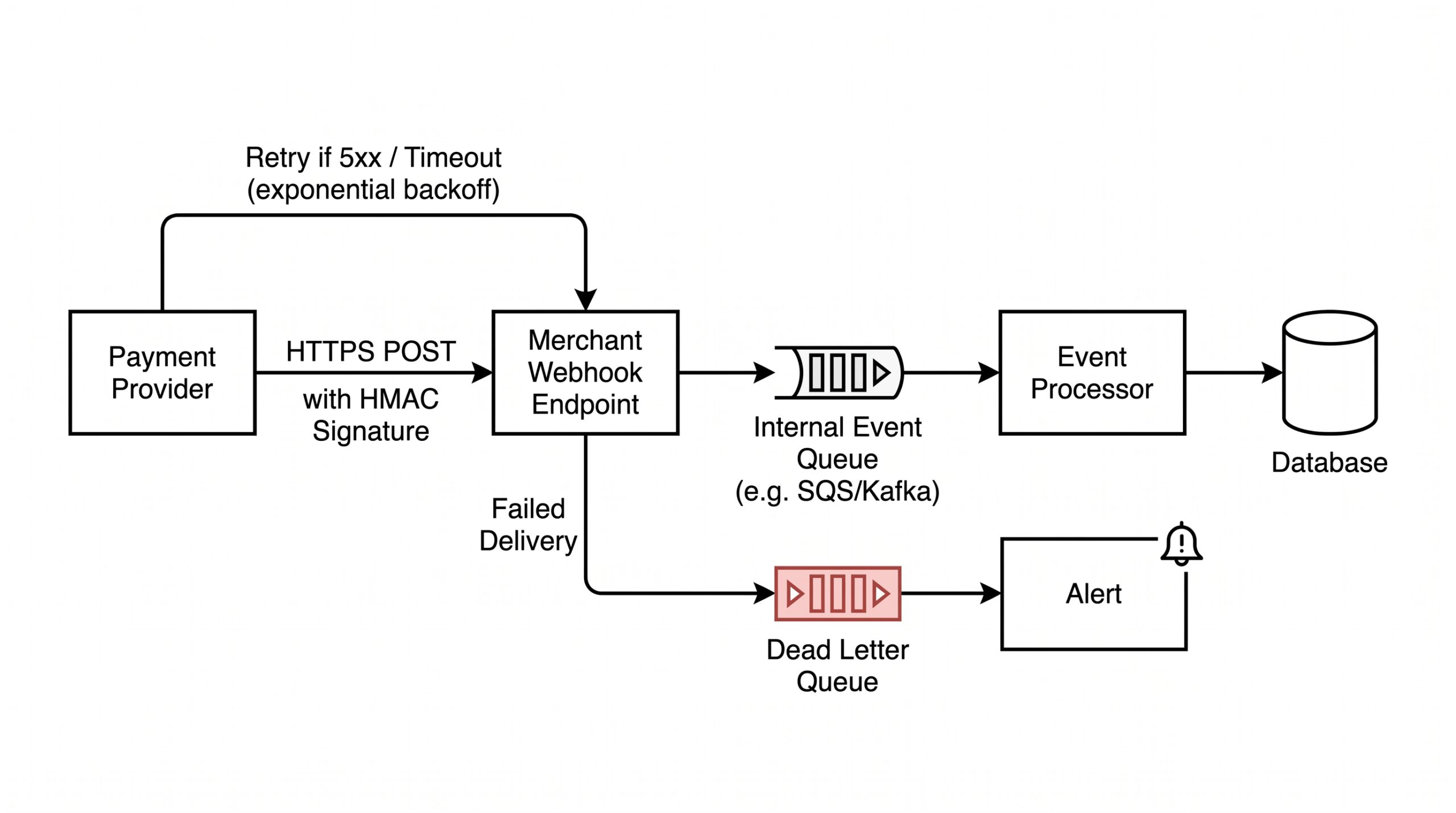
When a payment provider confirms a charge, processes a refund, or receives a chargeback, it cannot wait for you to poll an API. Instead, it makes an HTTP POST to a URL you register — a webhook endpoint — and delivers a signed JSON payload describing the event.
Why Webhooks Are Not Optional
Authorization responses tell you the bank approved the hold. Webhooks tell you when funds actually settle, when refunds complete, and when disputes are filed. Teams that skip webhook handling discover these facts later, through reconciliation failures or angry customer support tickets.
Key Event Types
| Event | Description | Action Required |
|---|---|---|
payment.succeeded | Funds captured successfully | Mark order paid, fulfil goods, send receipt |
payment.failed | Authorization declined or capture failed | Notify customer, release reserved inventory |
refund.created | Refund initiated | Update order status, queue customer notification |
dispute.created | Chargeback filed by cardholder | Alert support team, gather evidence for response |
payment.requires_action | 3D Secure authentication needed | Redirect customer to authentication flow |
Secure Webhook Handling
- Verify the signature. Every major gateway signs webhook payloads with HMAC-SHA256. Validate this before processing the event body. Reject unsigned or badly signed payloads with a 400 response.
- Return 200 immediately, then process asynchronously. Your endpoint should acknowledge the event and push it to an internal queue. Processing inside the HTTP request handler risks timeouts that cause the provider to retry, potentially triggering duplicate actions.
- Handle retries idempotently. Providers retry failed deliveries for hours or days. Your event handler must be idempotent — processing the same event twice must produce the same outcome as processing it once.
- Log everything. Store the raw event payload, the received timestamp, and your processing result. When reconciliation surfaces a discrepancy, you will need this audit trail.
5. Idempotency — Preventing Duplicate Payments
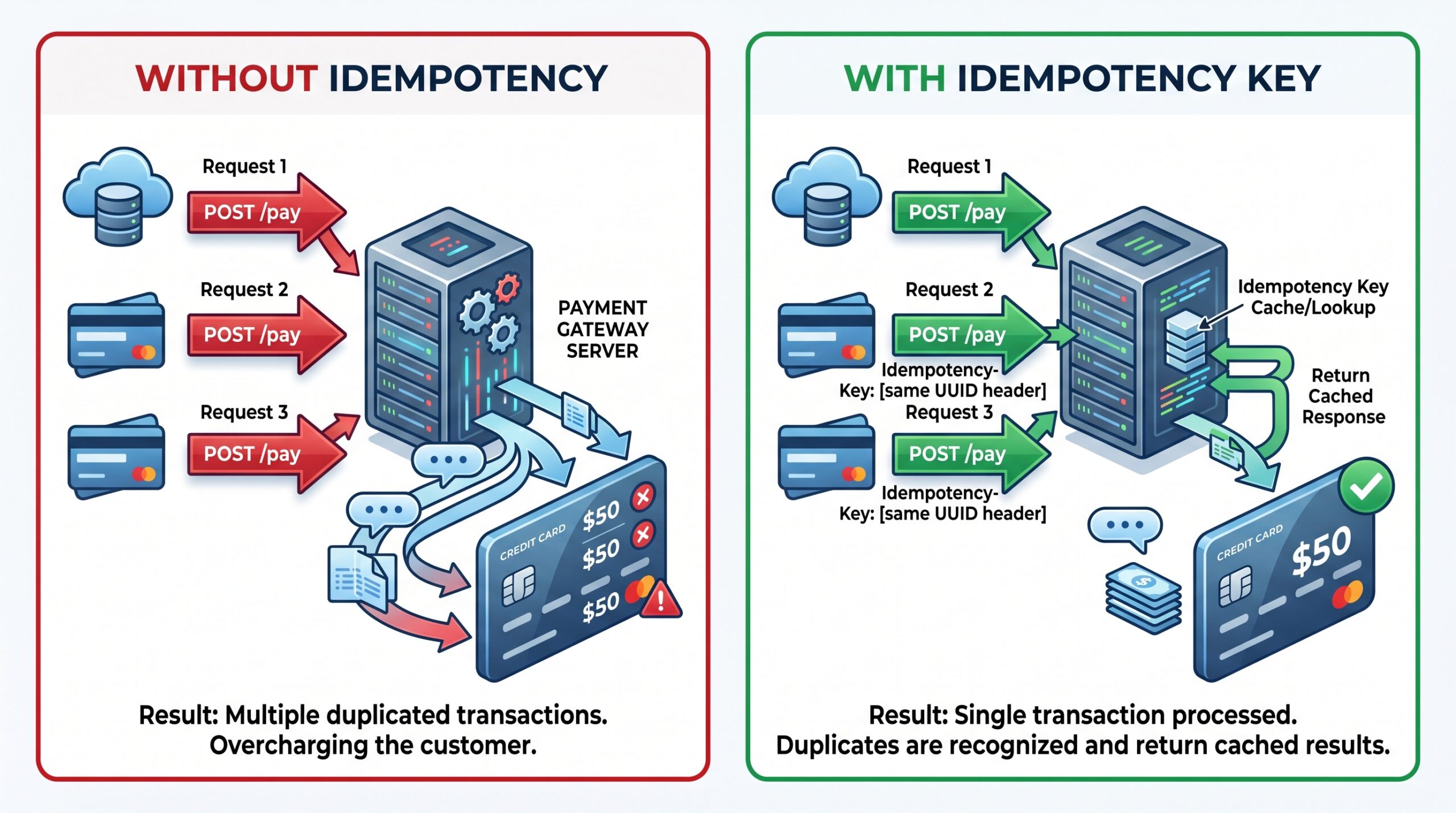
The user’s internet drops halfway through a charge. Their browser retries. Your load balancer’s health check misfires and routes the request twice. These are not edge cases — they are normal operating conditions. Without idempotency, each retry creates a new charge.
The Vulnerable Implementation
// DANGEROUS — no protection against duplicate requests
app.post("/pay", async (req, res) => {
  const result = await processPayment(req.body);
  res.json(result);
});processPayment() call — a second charge. The customer is billed twice. The merchant faces a chargeback. Support spends hours untangling it.
The Idempotent Implementation
// SAFE — idempotency key prevents duplicate charges
app.post("/pay", async (req, res) => {

  // 1. Extract the client-supplied idempotency key
  const key = req.headers["idempotency-key"];

  if (!key) {
    return res.status(400).json({ error: "idempotency-key header required" });
  }

  // 2. Check the cache — has this exact request already been processed?
  const cached = await cache.get(`idem:${key}`);
  if (cached) {
    // Return the original response without processing again
    return res.status(200).json(JSON.parse(cached));
  }

  // 3. Acquire a distributed lock before processing
  const lock = await redisLock.acquire(`lock:${key}`, 30_000);

  try {
    const result = await processPayment(req.body);

    // 4. Store result mapped to the idempotency key (TTL: 24 hours)
    await cache.set(`idem:${key}`, JSON.stringify(result), "EX", 86400);

    return res.json(result);
  } finally {
    await lock.release();
  }

});
Line by line: the client generates a unique key (a UUID tied to their specific cart/session) and sends it as a header. Your server checks Redis before doing any work. If the key exists, you return the cached response. The distributed lock prevents two concurrent requests with the same key from racing past the cache check simultaneously.
Storage Options for Idempotency Records
| Option | Pros | Cons |
|---|---|---|
| Redis (in-memory) | Sub-millisecond lookups, TTL built-in | Data loss if Redis cluster fails without persistence |
| Database unique constraint | Durable, part of transaction | Adds write latency to every payment |
| Both (Redis + DB) | Fast hot path, durable fallback | More complexity, two systems to keep consistent |
6. Common Payment System Failures
Most payment engineers spend more time handling failures than happy paths. Understanding the failure taxonomy is a prerequisite for building resilient systems.
Network Failures
Cause: Packet loss, DNS resolution failure, or TLS negotiation timeout between your service and the gateway API. Mitigation: Exponential backoff with jitter on retries; circuit breakers to stop cascading failures when a gateway is degraded.
Gateway Failures
Cause: Gateway-side outages or deployment incidents. Even Stripe and Adyen have incident histories. Mitigation: Multi-gateway routing. Route 80% of traffic to your primary gateway and 20% to a backup. Automatically shift more traffic to the backup when error rates on the primary exceed a threshold.
Processor Downtime
Cause: A processor’s connection to card networks becomes unavailable. Mitigation: Gateways that support multiple processors can reroute automatically. Monitor processor-specific decline rates as an early indicator.
Partial Failures and Unknown Outcomes
The most dangerous failure mode: you submit a charge, the network drops before you receive the response, and you do not know whether the payment succeeded. Mitigation: Every payment must have a server-side status field that transitions through states (pending → processing → succeeded/failed). A background job reconciles any payments stuck in processing by querying the gateway directly.
Timeouts
A request that takes 29 seconds and then times out is worse than an instant failure — your order system has been waiting. Mitigation: Set aggressive timeouts (5–10 seconds for gateway calls). Treat timeouts as unknown outcomes, not failures, and reconcile them asynchronously.
| Failure Type | Impact | Primary Mitigation |
|---|---|---|
| Network timeout | Unknown outcome | Async reconciliation job |
| Gateway outage | All payments blocked | Multi-gateway routing |
| Double charge | Customer complaint, chargeback | Idempotency keys |
| Lost webhook | Order stuck in pending | Idempotent retry handling |
| Database write failure | Payment processed, not recorded | Outbox pattern + reconciliation |
7. Fraud Prevention Architecture
Payment fraud costs the global economy tens of billions of dollars annually. For merchants, fraud means chargebacks (fees averaging $15–50 per dispute on top of the lost goods), account suspensions from card networks, and regulatory scrutiny. A fraud prevention system is not optional infrastructure — it is part of the product.
Velocity Checks
The simplest fraud signal: if a single card attempts 30 transactions in two minutes, something is wrong. Velocity rules count events within sliding time windows. A card that fails authorization three times in an hour gets soft-blocked and added to a review queue.
Device Fingerprinting
Legitimate users change devices occasionally. Fraud rings rotate card numbers on the same device. Fingerprinting captures browser attributes, screen resolution, fonts, and IP address to create a stable identifier that persists across card changes.
Geolocation Analysis
A card issued in Germany being used from a Nigerian IP address ten minutes after a transaction in Berlin is a strong fraud signal. Geolocation rules flag impossible travel and high-risk geographic combinations without blocking legitimate international use.
Risk Scoring and Machine Learning
Rules-based systems catch known patterns. ML models catch emerging ones. A trained model ingests dozens of features — transaction amount, merchant category, time of day, device, IP reputation, historical spend patterns — and outputs a risk score between 0 and 1. Transactions above 0.85 are declined; those between 0.6 and 0.85 may trigger step-up authentication (3D Secure).
8. Designing for Scalability
A payment system that handles 100 transactions per day and one that handles 1 million per day share the same business logic. They share almost nothing in their infrastructure. Growth is not just an ops problem — it shapes the architecture from day one if you plan for it.
The Scaling Journey
| Scale | Architecture | Key Bottleneck |
|---|---|---|
| 100 tx/day | Single server, single Postgres instance | None — over-engineering at this stage is waste |
| 10,000 tx/day | Horizontal app servers behind load balancer, read replicas | Database write throughput |
| 100,000 tx/day | Service decomposition, Redis caching, message queues | Gateway API rate limits |
| 1,000,000+ tx/day | Database sharding, Kafka event bus, async processing, multi-region | Cross-service coordination, distributed consistency |
Database Sharding
A single Postgres instance can handle roughly 5,000–10,000 writes per second before performance degrades. At scale, shard payment records by customer ID or merchant ID. This distributes write load, but introduces complexity: cross-shard queries require application-level fan-out, and sharding is effectively irreversible without significant migration effort.
Message Queues and Async Processing
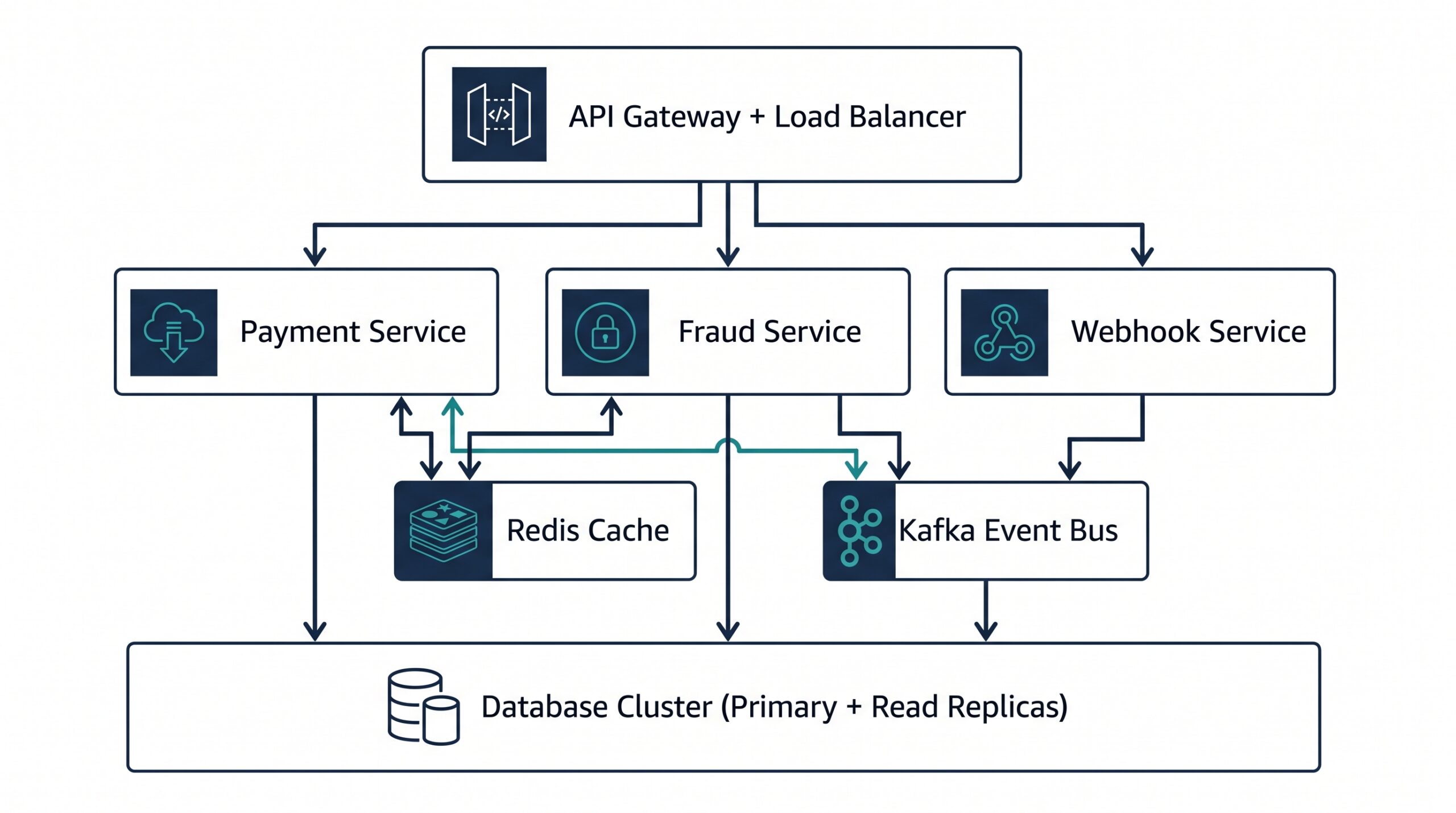
Fraud analysis, webhook delivery, email notifications, and ledger updates do not need to block the authorization response. Push these to a Kafka topic or SQS queue and process them asynchronously. This reduces the synchronous latency of your payment API from hundreds of milliseconds to tens — and allows each consumer to scale independently.
Service Isolation
A fraud service experiencing high CPU load should not degrade payment authorization latency. Decompose into isolated services with independent compute, databases, and failure boundaries. Use circuit breakers at service boundaries so a fraud service timeout degrades gracefully (fall through to a default risk decision) rather than blocking the payment.
9. Security Best Practices
Payment systems are high-value targets. A compromised payment service can expose card numbers, enable unauthorized transfers, and result in millions of dollars in fraud liability. Security is not a layer you add at the end — it is woven into every design decision.
TLS Everywhere
All communication — external API calls, internal service-to-service traffic, database connections — must use TLS 1.2 or 1.3. Certificate pinning in mobile clients prevents man-in-the-middle attacks even if a CA is compromised.
Tokenization vs Encryption
Encryption is reversible with the right key. Tokenization is a lookup against a vault. If an attacker compromises your database and your encryption keys, encrypted card data can be decrypted. Tokens alone are useless without access to the vault. Prefer tokenization for card data storage.
PCI DSS Scope Management
PCI DSS compliance is complex and expensive. The single most effective step is ensuring your application never touches raw card data. Use gateway-hosted payment fields (iFrames or SDKs) so card numbers are submitted directly to the gateway’s servers and your network never sees them.
Rate Limiting
Enforce per-customer and per-IP rate limits on your payment endpoint. A customer hitting /pay 50 times in a second is either a buggy integration or an attack. Rate limits prevent card testing attacks where attackers try thousands of stolen card numbers to find valid ones.
Secrets Management
API keys, gateway credentials, and encryption keys should never appear in source code, environment variables checked into version control, or application logs. Use a secrets manager (AWS Secrets Manager, HashiCorp Vault) and rotate credentials regularly.
| Security Control | Protects Against | Implementation |
|---|---|---|
| TLS 1.3 | Interception, MITM | Enforce at load balancer; reject lower versions |
| Tokenization | Card data breach | Gateway SDK; never log raw PANs |
| HMAC signatures | Webhook spoofing | Validate on every inbound webhook |
| Rate limiting | Card testing, brute force | Redis-backed sliding window per IP/customer |
| Audit logging | Insider threats, forensics | Immutable append-only log for all payment state transitions |
| Secrets manager | Credential exposure | No secrets in code; rotate every 90 days |
10. Settlement and Reconciliation
Authorization is a promise. Settlement is the actual movement of money. Understanding the difference — and the gap between them — is fundamental to financial accuracy.
Authorization vs Capture vs Settlement
- Authorization: The bank reserves funds on the customer’s card. No money has moved. The hold typically expires in 5–7 days if not captured.
- Capture: You instruct the bank to collect the authorized funds. Capture can be the same amount or less than the authorization (useful for hotels adjusting for actual charges).
- Settlement: The card network batches all captures from the day and transfers net funds to the merchant’s acquiring bank, typically overnight.
Why Reconciliation Systems Are Critical
At the end of each business day, your payment processor sends a settlement file listing every captured transaction. Your reconciliation system compares this file against your internal transaction database. Discrepancies indicate one of: a transaction that appeared in your database but not in the settlement (a failed capture you thought succeeded), a transaction in the settlement but not your database (a payment processed but not recorded — perhaps due to a database write failure), or a settlement amount that does not match your records (a fee applied incorrectly).
Teams without reconciliation find these discrepancies weeks later, often through customer complaints or accountant queries. Build reconciliation from day one, even if you run it manually at first.
11. Observability and Monitoring
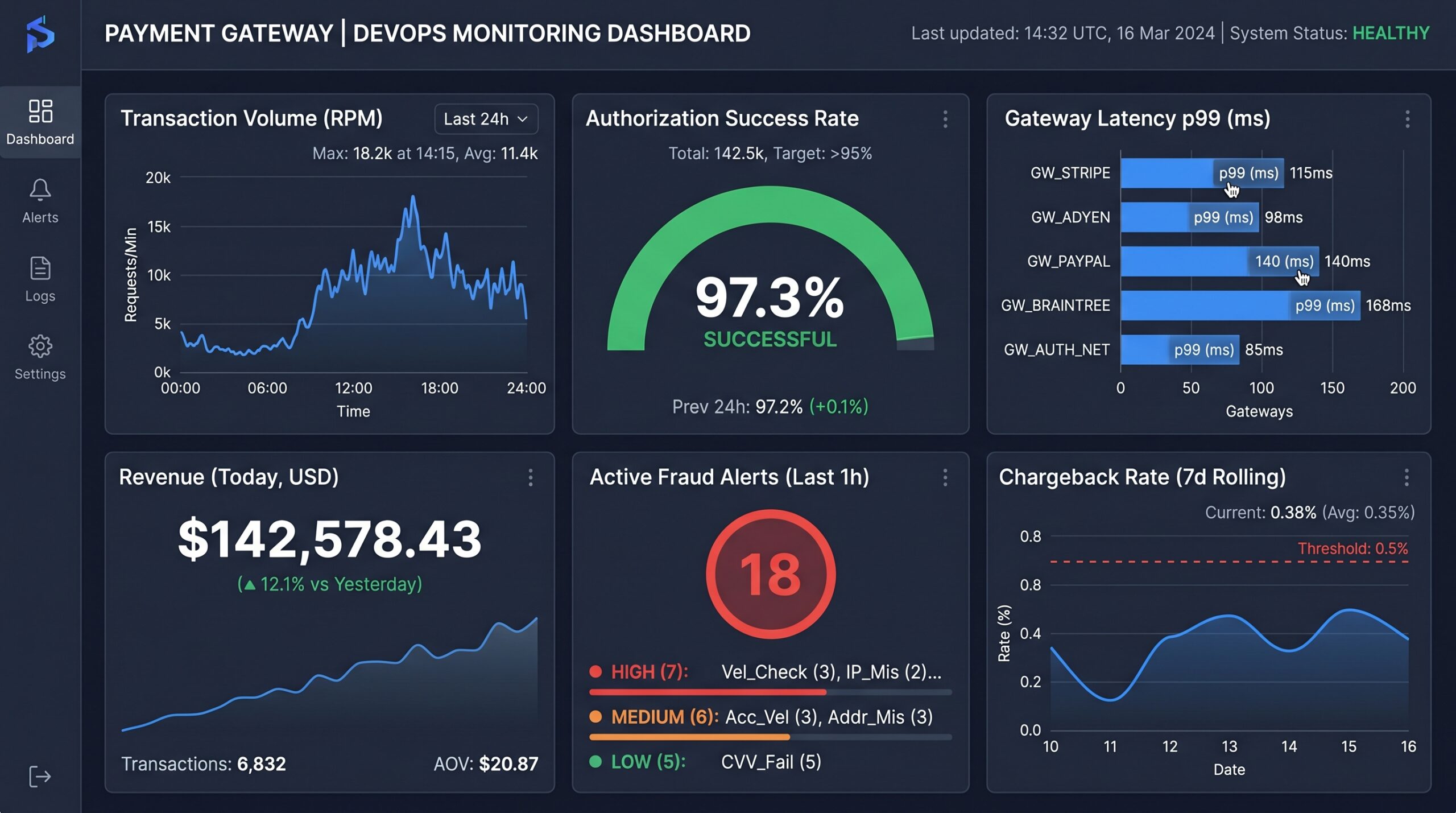
A payment system without observability is a black box. When something goes wrong — and it will — you need to know within seconds, not minutes, and you need the data to diagnose the root cause.
Key Metrics to Track
| Metric | Target | Alert Threshold |
|---|---|---|
| Authorization success rate | > 97% | Alert if drops below 95% |
| Gateway API p99 latency | < 2,000ms | Alert if exceeds 3,000ms |
| Webhook delivery failure rate | < 0.1% | Alert if exceeds 1% |
| Fraud decline rate | Baseline ± 2σ | Alert on sudden spikes (attack) or drops (model failure) |
| Chargeback rate | < 0.5% | Card networks suspend merchants above 1% |
| Reconciliation discrepancy count | 0 | Alert on any discrepancy |
Logging, Metrics, and Tracing
Structured logging (JSON) for every payment state transition. A distributed trace ID that spans from the initial API request through every downstream service call — so when a transaction fails, you can replay the entire event sequence in your tracing tool. Metrics (Prometheus or CloudWatch) for dashboards and alerting. Dead simple dashboards focused on the four signals that matter: volume, error rate, latency, and fraud rate.
12. Real-World Payment System Architecture
Let us design a hypothetical payment platform serving 10 million users across multiple countries and currencies. Call it PayCore.
Service Decomposition
| Service | Responsibility | Data Store |
|---|---|---|
| Payment API | Accepts payment intents, validates requests, returns responses | Postgres (sharded by customer_id) |
| Gateway Router | Selects gateway based on card type, geography, and error rates | Redis (routing config + circuit breaker state) |
| Fraud Engine | Real-time risk scoring; consumes events from Kafka | Redis (velocity counters), ML model store |
| Webhook Dispatcher | Delivers events to merchant endpoints with retry and backoff | Postgres (event log), Redis (retry state) |
| Ledger Service | Double-entry accounting for every fund movement | Separate Postgres with append-only ledger table |
| Reconciliation Job | Nightly comparison of internal records vs settlement files | Reads from Ledger + S3 settlement files |
| Notification Service | Email/SMS receipts, fraud alerts, dispute notifications | SQS queue → SendGrid / Twilio |
Architectural Decisions
- Kafka as the nervous system. Every significant event (payment intent created, authorized, captured, failed, refunded) is published to a Kafka topic. Downstream services consume events independently without tight coupling to the Payment API.
- Separate ledger database. Financial integrity requires that the accounting record is separate from the operational database. The ledger is append-only — no updates, no deletes — and is replicated to a read-only analytics cluster.
- Multi-region active-passive. The payment API is active in two AWS regions. In a regional failure, Route 53 health checks fail over traffic to the secondary region within 60 seconds. The primary region’s Postgres replication lag is monitored; a lag above 1 second triggers an alert before failover is considered.
- Currency as a first-class entity. All amounts are stored as integers in the transaction’s native currency alongside the ISO 4217 currency code. Currency conversion for reporting is applied at query time, not at write time, to avoid irreversible rounding decisions.
13. Payment System Interview Questions
Idempotency means that making the same API request multiple times produces the same result as making it once. In payments, this prevents a user who retries a timed-out request from being charged multiple times. You implement it with a client-supplied idempotency key that your server uses to look up and return a cached response for repeated requests.
A gateway accepts a payment request from a merchant’s application, tokenizes or encrypts the card data, validates the request, runs fraud screening, and routes the authorization request to the appropriate payment processor. The processor communicates with card networks (Visa, Mastercard) and the issuing bank, receives a response, and returns it to the gateway, which returns it to the merchant.
Three layers: (1) client-side — disable the submit button after the first click; (2) idempotency key — the server checks if this key has been seen before processing; (3) database unique constraint on a payment reference ID — even if two requests race past the idempotency check simultaneously, only one write succeeds.
A webhook is an HTTP POST from a payment provider to your registered endpoint, triggered by an event (payment succeeded, refund processed). You handle them reliably by: verifying the HMAC signature, returning 200 immediately and processing asynchronously, making all handlers idempotent, and logging every event payload for audit and debugging.
Horizontally scale the API layer behind a load balancer. Decompose into services (payment API, fraud engine, webhooks, ledger). Shard the database by customer ID. Introduce Kafka for async event processing. Cache gateway routing decisions and velocity counters in Redis. Monitor and circuit-break each external dependency. Consider multi-region active-passive for high availability.
A layered system: deterministic rules (velocity limits, card type restrictions, geolocation blocks) run first because they are fast and cheap. An ML model then scores the transaction against dozens of features. High-risk transactions are declined or sent to 3DS authentication. Models are retrained regularly against confirmed fraud labels, and authorization rates by customer segment are monitored as a false-positive proxy.
Authorization is a hold; settlement is the actual fund transfer. After capture, the card network batches all transactions and transfers net amounts from issuing banks to acquiring banks, typically overnight. Settlement files arrive from your processor the next business day and must be reconciled against your internal records to catch discrepancies.
Frequently Asked Questions
- What is a payment gateway?
- A payment gateway is the technology layer that accepts payment requests from merchants, encrypts card data, screens for fraud, and routes authorization requests to the payment processor. Modern gateways expose REST APIs and JavaScript SDKs that allow merchants to accept payments without handling raw card numbers.
- What is a payment processor?
- A payment processor is the entity that communicates directly with card networks (Visa, Mastercard) and issuing banks to authorize, clear, and settle transactions. The processor handles the financial messaging layer beneath the gateway’s API surface.
- How do payment systems work?
- A customer submits card details. The merchant sends a tokenized payment request to a gateway. The gateway screens it for fraud and routes it to a processor. The processor sends an authorization request through the card network to the issuing bank. The bank approves or declines and returns a response. The entire round trip typically completes in under two seconds.
- Why are webhooks important in payment systems?
- Webhooks enable real-time event-driven updates. Rather than polling an API every few seconds to check whether a payment settled or a refund completed, your application receives a push notification the moment the event occurs. This keeps order state accurate and enables timely customer notifications.
- What is PCI DSS?
- The Payment Card Industry Data Security Standard is a set of technical and operational requirements that any business storing, processing, or transmitting card data must comply with. It covers network segmentation, encryption, access controls, vulnerability scanning, and audit logging. Using a gateway that handles card data can significantly reduce your compliance scope.
- What causes duplicate payments?
- Duplicate payments occur when a user clicks submit multiple times, a client retries a request that timed out before the server could respond, or a server restart re-processes an in-flight operation. Without idempotency controls, each attempt creates a new charge.
- What is payment reconciliation?
- Reconciliation is the daily process of comparing your internal payment records against settlement files provided by your processor and bank. It surfaces discrepancies such as charges that succeeded at the processor but were not recorded in your database, or settlement amounts that differ from what you authorized.
- How does fraud detection work in payment systems?
- Fraud engines combine deterministic rules (velocity checks, geolocation blocks) with machine learning models that score transactions against behavioral and contextual features. A risk score output determines whether to approve, challenge with 3DS, or decline the transaction. Models are continuously retrained as fraud patterns evolve.
- What is tokenization in payments?
- Tokenization replaces a sensitive card number with a non-sensitive surrogate (a token) stored in a secure vault. Your application stores and transmits the token. Only the vault can resolve a token back to the real card number. If your database is breached, attackers obtain useless tokens rather than live card numbers.
- What is payment settlement and how long does it take?
- Settlement is the batch process by which authorized and captured funds are actually transferred from a customer’s issuing bank to the merchant’s acquiring bank through the card network. Authorization happens in seconds; settlement typically takes one to three business days, depending on the card network, processor, and merchant account configuration.
Conclusion: Building Systems That Deserve Financial Trust
Every section in this guide traces back to a single principle: in payment systems, the consequences of failure are financial, not just technical. Customers lose money. Merchants face chargebacks. Regulatory action follows patterns of negligence. The engineering bar is higher here than almost anywhere else in software.
The key lessons to carry forward:
- Build for unknown outcomes. Assume the network will drop your response half the time. Design every operation to be safe to retry.
- Never touch raw card data. Tokenize at the point of entry. Reduce your PCI scope aggressively.
- Idempotency is not optional. Implement it at every layer — client, server, and database — before you write a single payment API endpoint.
- Webhooks need the same reliability engineering as your payment API. Idempotent handlers, signature verification, and full payload logging are non-negotiable.
- Observability is a first-class feature. Authorization success rate, p99 latency, and chargeback rate are your primary health signals. Alert on them before customers notice.
- Reconcile every day. Discrepancies found in hours cost dozens of dollars to fix. Discrepancies found in weeks cost thousands — in support time, regulatory exposure, and customer trust.
Payment infrastructure is rarely glamorous. It runs in the background, invisible when it works, devastating when it does not. The engineers who build it well do not just understand distributed systems — they understand that the systems they build are handling real people’s money, and they design accordingly.